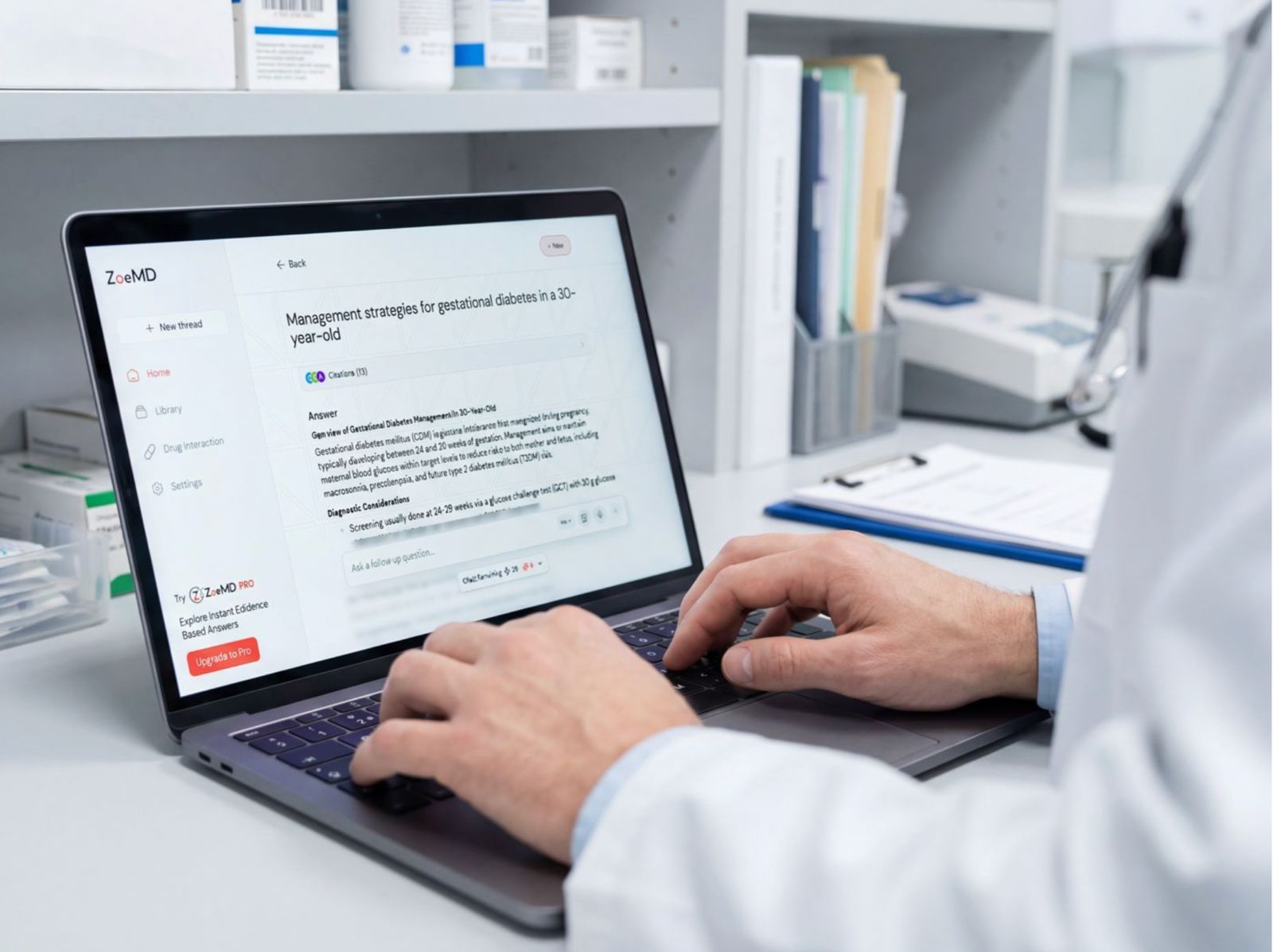

Why a citation is not a badge of truth—but a route from a clinical claim back to evidence.
Bottom line: ZoeMD reduces hallucination risk by shortening the distance between an answer and the evidence behind it. The safety feature is not simply that a citation appears—it is that clinicians can open the source, test the claim, and decide whether the evidence fits the patient and setting.
Medical AI hallucinations are usually described as facts or references that an AI system invents. That definition is too narrow for clinical work. An answer can cite a real paper and still be unsafe because the paper does not support the claim, the study population does not match the patient, the guidance is outdated, or a critical exception is omitted.
This is why ZoeMD is built around evidence retrieval and source-linked answers rather than asking clinicians to trust polished language alone. The goal is not to make AI sound more certain. It is to make the answer inspectable.

The Most Dangerous Hallucination May Look Completely Plausible
A 2026 study of 1,800 AI-generated anatomy references found that even the best-performing model in the comparison hallucinated 23.2% of references, and only 67.2% of its citations fully supported the associated content. Read the PubMed record.
Another 2026 analysis of 12,197 diagnostic-model outputs found three different hazards: fabricated guidance, inconsistent guideline citation, and omission of relevant guidelines. The omission rate reached 97% in one tested model and 46% in another. Read the BMJ Health & Care Informatics study.
Those findings matter because fluent wording can hide several distinct failures. The practical question is not only “Is this citation real?” It is “Does this source support this exact claim for this clinical context?”
Five Ways a Cited Medical Answer Can Still Fail
| Failure | Why it can look trustworthy | What must be checked |
|---|---|---|
| Source fabrication | The title, journal, authors, or DOI look realistic. | Confirm that the source exists in the publisher, PubMed, or guideline repository. |
| Claim–source mismatch | The cited paper is real and topically related. | Verify that its actual findings support the precise statement—not merely the general topic. |
| Clinical-fit failure | The evidence is valid in the population studied. | Check age, comorbidities, exclusions, setting, intervention, comparator, and jurisdiction. |
| Recency failure | An older guideline still appears authoritative. | Check version, update date, retractions, safety notices, and newer guidance. |
| Omission | Every sentence shown may be technically correct. | Ask what was excluded: competing guidance, contraindications, uncertainty, and missing evidence. |
How ZoeMD Is Designed to Reduce Hallucination Risk
ZoeMD’s public workflow can be summarized as question → evidence search → cited synthesis → clinician review. That sequence changes the model’s job. Instead of producing a medical answer from conversational fluency alone, the system is designed to find relevant evidence and return an answer connected to sources the user can inspect.

- Evidence is retrieved before it is applied. ZoeMD says it searches more than 39 million medical sources, including peer-reviewed literature, clinical guidelines, and medical databases.
- Major claims are accompanied by citations. This makes the source basis visible instead of hiding it inside a confident paragraph.
- Sources are directly accessible. A clinician can move from the answer to the original evidence without reconstructing the search from scratch.
- The output remains reviewable. FDA guidance for certain clinical decision-support functions emphasizes enabling health professionals to independently review the basis of recommendations rather than rely primarily on them.
- Clinical judgment remains the final layer. Citations reduce hidden uncertainty; they do not replace history, examination, local policy, specialist input, or professional accountability.
This is a risk-reduction architecture, not a claim that hallucinations are impossible. Retrieval-augmented medical question answering has been shown to reduce—not eliminate—hallucinations. One comparative study reported a mean reduction of 15.1% after adding retrieval and fact/safety filtering to four language models. Read the JMIR/PubMed study.
The Three Layers of Citation Integrity
Most online advice stops at citation validity: does the reference exist? For clinical use, two more layers are required.
| Layer | Question | Pass condition |
|---|---|---|
| 1. Citation validity | Is the source real and identifiable? | The title, authors, journal or organization, date, and link resolve correctly. |
| 2. Claim coverage | Does the source support the exact decision-critical claim? | The cited text or data supports the statement without stretching the conclusion. |
| 3. Clinical fit | Does that evidence apply here? | Population, setting, intervention, exclusions, jurisdiction, and recency fit the question. |
A useful rule: A citation can pass Layer 1 and still fail Layers 2 or 3. That is why a real reference is not the same thing as a clinically supported answer.
The ZoeMD Claim-to-Source Loop
For high-impact questions, use ZoeMD’s citations as an active review loop rather than a passive reference list.
- Isolate the decision-critical claim. Identify the sentence that could change diagnosis, medication selection, dosing, referral, escalation, or patient counseling.
- Open the citation attached to that claim. Do not start with every source. Start with the one supporting the highest-risk statement.
- Verify exact support. Confirm the source says what the answer says. Check outcomes, effect size, thresholds, and recommendation strength where relevant.
- Test clinical fit. Compare the source population and setting with the patient, jurisdiction, local formulary, and institutional protocol.
- Search the negative space. Ask what the answer omitted: exclusions, adverse effects, conflicting guidance, evidence gaps, or situations requiring escalation.
- Apply and document judgment. The final decision belongs to the clinician. When appropriate, record the actual guideline or study reviewed—not the AI answer alone.
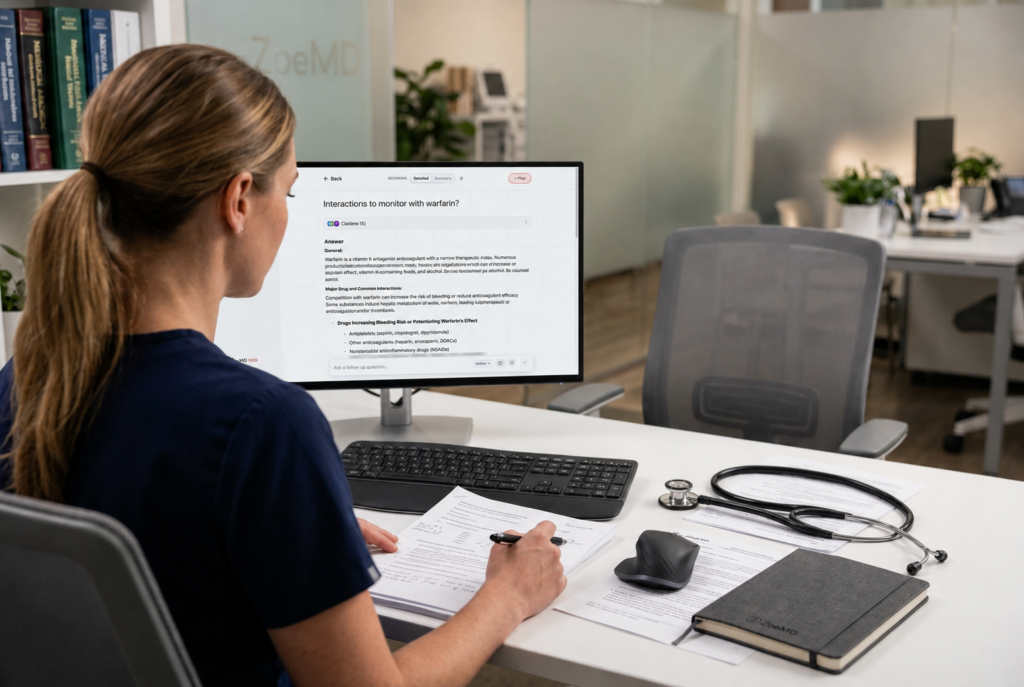
The Failure Mode Most Articles Miss: Omission
A hallucination adds information that is unsupported. An omission removes information that may be essential. In practice, omission can be harder to detect because the answer may contain no obviously false sentence.
For example, an answer may accurately summarize a treatment recommendation but fail to mention that the guideline excludes pregnancy, severe renal impairment, a particular age group, or a time-critical presentation. It may cite one respected guideline but omit a conflicting regional standard. It may present a precise threshold without disclosing that the evidence is observational or low certainty.
ZoeMD’s citations give clinicians a way to detect this “negative space.” The source can be inspected for exclusions and limitations, and the user can ask targeted follow-up questions that force uncertainty into view.
Five Follow-Up Prompts That Make Citations More Useful
These prompts are designed for de-identified clinical questions. They do not ask ZoeMD for a final decision; they ask it to make the evidence trail more inspectable.
- “List the decision-critical claims in your answer and attach the most relevant source to each one.”
- “For each cited source, state the population, setting, intervention, comparator, and main limitation.”
- “Which patients or clinical situations were excluded from the evidence you cited?”
- “Do current guidelines disagree by specialty, country, or publication date? Show the disagreement with sources.”
- “What important part of this question is not answered by the available evidence?”
Why these prompts are different: They do not merely request more citations. They test citation coverage, applicability, disagreement, and missing evidence—the places where a plausible answer can still mislead.
A Practical Example: Turning a Fast Answer Into an Auditable Answer
Suppose a clinician asks a de-identified question about whether a general recommendation applies to an older adult with renal impairment, multiple medications, and a local formulary constraint.
- First pass: orientation. Use ZoeMD to retrieve a cited overview of the current evidence and guidelines.
- Second pass: claim mapping. Ask ZoeMD to separate the recommendation, contraindications, monitoring requirements, and escalation triggers, with a source for each.
- Third pass: applicability. Open the source behind the recommendation and check renal criteria, age range, drug exclusions, care setting, and publication date.
- Fourth pass: uncertainty. Ask whether guidelines disagree and what the evidence does not answer.
- Final pass: professional decision. Compare the evidence with the patient, local policy, approved drug references, and specialist or pharmacist input as appropriate.
The valuable output is not simply “yes” or “no.” It is a transparent classification: supported for the population studied, uncertain for a specific subgroup, contradicted by another guideline, or not answered by the available evidence. That is a more useful clinical product than confidence alone.
What ZoeMD Citations Can—and Cannot—Do
| Citations can | Citations cannot |
|---|---|
| Expose the evidence trail behind an answer. | Guarantee that every source is interpreted correctly. |
| Make fabricated or irrelevant references easier to detect. | Supply patient context that was never entered or examined. |
| Reduce the time required to move from question to source. | Replace local protocols, formularies, examination, or specialist judgment. |
| Make uncertainty and disagreement easier to investigate. | Turn an evidence summary into an autonomous clinical decision. |
When Not to Rely on Any AI Answer
- When the situation is time-critical and immediate escalation or an established emergency pathway is required.
- When the answer depends on information the system does not have, such as examination findings, full records, imaging interpretation, or local operational context.
- When decision-critical claims do not have accessible sources.
- When the cited source cannot be found, does not support the claim, or applies to a different population.
- When institutional policy, an approved drug reference, a specialist, or a pharmacist must govern the decision.

The Real Value of Citation-First Medical AI
The safest medical AI is not the system that sounds most certain. It is the system that makes its evidence easiest to challenge.
ZoeMD’s value is the shorter, more transparent path from a clinical question to source-linked evidence. Citations make an answer falsifiable. They let the clinician verify what is supported, discover what is missing, and keep professional judgment in control.
Explore ZoeMD for cited clinical answers, or continue reading about AI medical assistants with citations, evidence-based medical AI at the point of care, and AI medical search versus traditional search.
FAQ
Does ZoeMD eliminate medical AI hallucinations?
No responsible medical AI tool should be described as incapable of error. ZoeMD is designed to reduce hallucination risk by retrieving medical evidence, attaching citations, and giving clinicians direct routes to review the underlying sources.
Why are direct source links important?
A reference list can create the appearance of authority. A direct source link lets the clinician confirm that the source exists, supports the claim, is current, and applies to the clinical context.
Can a real citation still support a wrong answer?
Yes. A source may be real but irrelevant, interpreted too broadly, outdated, or based on a different population or setting. Citation validity is only the first layer of verification.
What should clinicians verify first?
Start with the statement most likely to change care: diagnosis, dosing, contraindications, red flags, escalation, or treatment selection. Open the source attached to that claim before reviewing lower-risk details.
What is the best way to ask ZoeMD a clinical question?
Use a focused, de-identified question that includes the relevant population, setting, comorbidities, decision point, and jurisdiction. Then ask for sources, exclusions, conflicting guidance, and evidence gaps.
Medical Disclaimer
This article is for informational and educational purposes only. It is not medical advice and does not replace professional clinical judgment, diagnosis, treatment, local protocols, emergency care, approved drug references, pharmacist review, or specialist consultation.