


A useful clinical evidence search workflow does more than produce a fast answer. It turns a care question into a structured search, shows the supporting sources, helps the clinician identify uncertainty, and leaves the final interpretation with the professional responsible for the decision.
ZoeMD is designed to help clinicians ask medical questions in natural language and review evidence-linked responses. The workflow below shows how to use that capability responsibly with a fictional, de-identified question.
Quick answer
Use ZoeMD by asking a focused, appropriately de-identified question; requesting the evidence type needed; reviewing scope and uncertainty; opening the citations; challenging the first answer; and independently confirming any claim that could change care. ZoeMD supports evidence navigation, not autonomous clinical decisions.
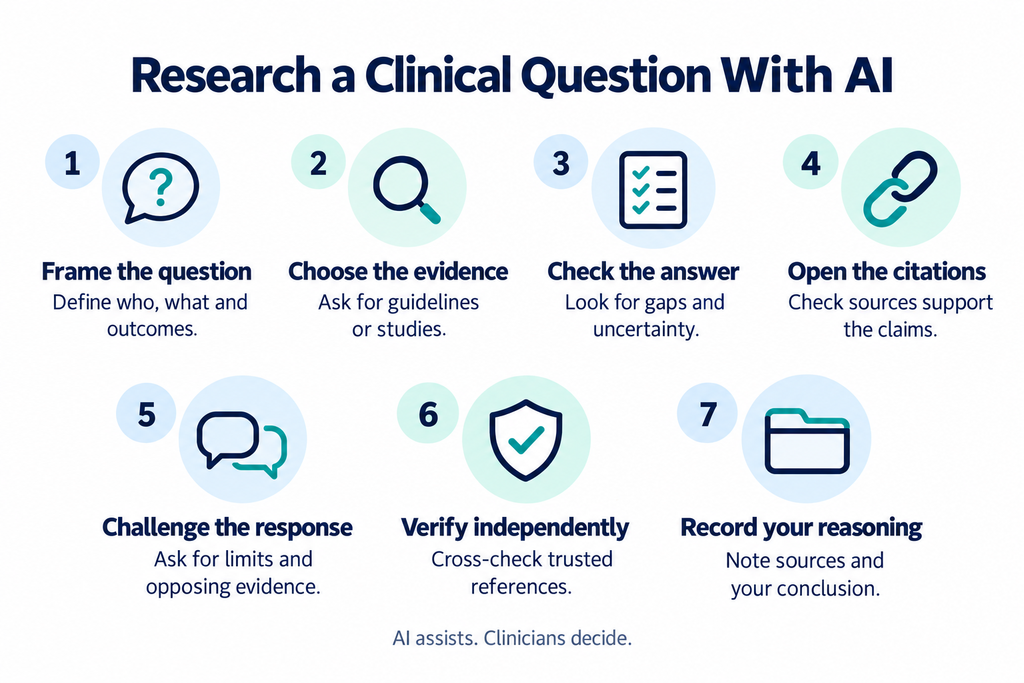
1. Formulate the question
Suppose a clinician wants to review evidence about treatment options for an adult with a common condition. Avoid entering identifying patient details. Instead, describe only the clinical factors required to retrieve relevant evidence: age range, condition, intervention, comparator, outcomes, major comorbidities, setting, and guideline jurisdiction.
Example structure: For adults with [condition] in [setting], how does [intervention] compare with [alternative] for [outcomes], and what major contraindications or monitoring requirements should be reviewed?
The structure resembles PICO and makes it easier to see whether the answer addresses the intended population and outcome.
2. Ask for the evidence type you need
A broad answer may mix guidelines, systematic reviews, trials, and background material. Ask for a current guideline first when the question concerns standard management. Ask for systematic reviews or primary trials when comparing benefits and harms. For diagnosis, request evidence about test performance in a population that resembles the intended setting.
ZoeMD’s article on evidence retrieval for clinicians explains how the source type should follow the question rather than the convenience of the search tool.
3. Read the answer for scope and uncertainty
Before opening references, ask whether the response answered the question you posed. Look for missing comparators, unaddressed harms, population differences, and claims that appear more certain than the evidence allows.
- Does the response state the population and setting?
- Does it separate evidence from interpretation?
- Does it acknowledge conflicting guidance or limited evidence?
- Does it identify factors that could change applicability?
4. Open and inspect the citations
Use the direct source links. Confirm that each important citation exists and supports the adjacent claim. Review the issuing organization, study design, publication date, sample, intervention, comparator, outcomes, effect size, and limitations.
The article How AI medical assistants use citations provides a fuller checklist. A source can be authentic and still be too old, too indirect, or irrelevant to the patient population.

5. Challenge the first answer
Use follow-up questions to expose uncertainty rather than to obtain a more confident version of the same conclusion.
- What evidence contradicts this conclusion?
- Which recommendation is conditional or based on low-certainty evidence?
- How would the answer change with renal impairment, pregnancy, frailty, or polypharmacy?
- Are there newer guidelines or safety communications?
- Which claims are not directly supported by the cited sources?
If differential diagnosis is part of the question, use the workflow in AI for differential diagnosis to broaden and check possibilities without handing diagnostic authority to the tool.
6. Verify independently
Search an authoritative resource outside the initial answer. PubMed Clinical Queries, current society guidelines, regulatory labels, and local protocols can help confirm that the response did not omit a major source or recent update.
For high-risk, unfamiliar, or contested questions, seek specialist, pharmacist, librarian, or institutional guidance as appropriate.
7. Record what was reviewed
Follow organizational policy for documentation. A useful internal record may include the question, search date, sources reviewed, unresolved uncertainty, and the clinician’s independent conclusion. Do not copy an AI response into the medical record without appropriate review, context, and authorization.
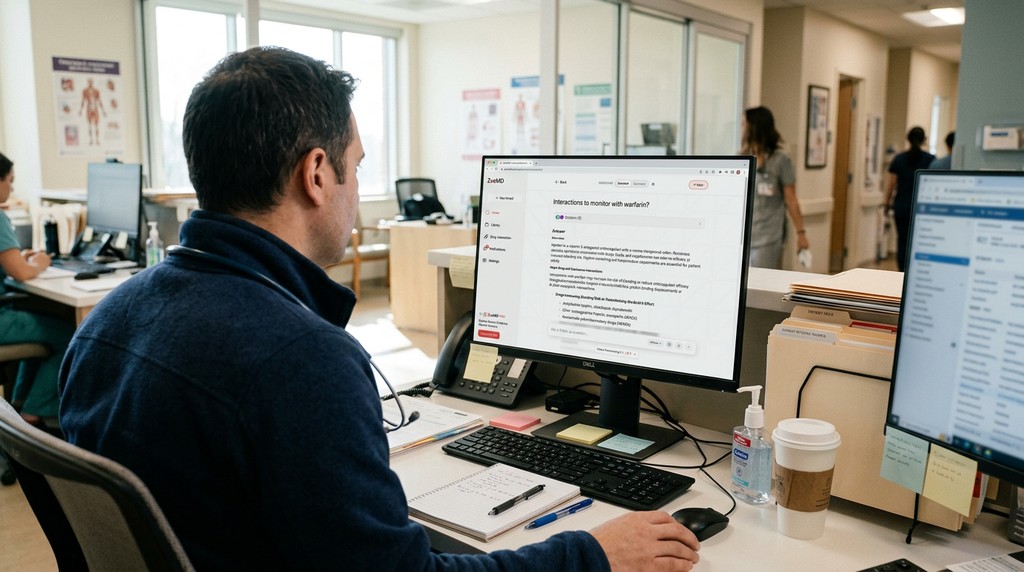
Use ZoeMD as an evidence navigation tool
The value of ZoeMD is not a polished paragraph by itself. It is the ability to move from a structured clinical question to sources that a clinician can inspect. The responsible workflow remains question, retrieval, verification, interpretation, and professional judgment.
Build a repeatable evidence-search habit
This workflow is the practical spoke of the clinical evidence search guide. Reusing the same question structure and verification sequence helps clinicians compare results over time and recognize when an answer has drifted beyond the evidence.
Different roles can adapt the workflow. Family physicians may classify the question first, pharmacists may begin with the complete medication context, and hospitalists may define the immediate decision and transition point.
Common mistakes to avoid
- Entering unnecessary identifiers instead of a focused, appropriately de-identified question.
- Asking for “the answer” without specifying the decision, setting, outcome, or evidence type.
- Following a summary without opening the sources attached to important claims.
- Copying generated wording into a clinical record without review, context, authorization, and policy alignment.

Frequently asked questions
What information should a ZoeMD question include?
Include only the clinical factors needed for retrieval, such as age band, condition, setting, intervention, comparator, outcomes, comorbidities, organ function, and jurisdiction. Avoid unnecessary identifiers.
Should the first response be accepted as final?
No. Check whether it answered the intended question, open the citations, request conflicting evidence and limitations, and independently verify claims that could change care.
Can ZoeMD replace PubMed or a guideline repository?
ZoeMD can shorten the route to relevant evidence and cited summaries. Authoritative databases, current guidelines, regulatory sources, and local protocols remain important for independent confirmation and deeper appraisal.
Related evidence search guides
- Clinical evidence search guide
- How to verify AI medical answers
- Evidence search for family physicians
- Clinical evidence retrieval for hospitalists
- Evidence-based medical AI at the point of care
Sources and further reading
Clinical note: Use fictional or appropriately de-identified examples unless your organization has explicitly approved the product, agreement, and workflow for protected health information. ZoeMD supports clinical decision-making; it does not replace clinician judgment.