

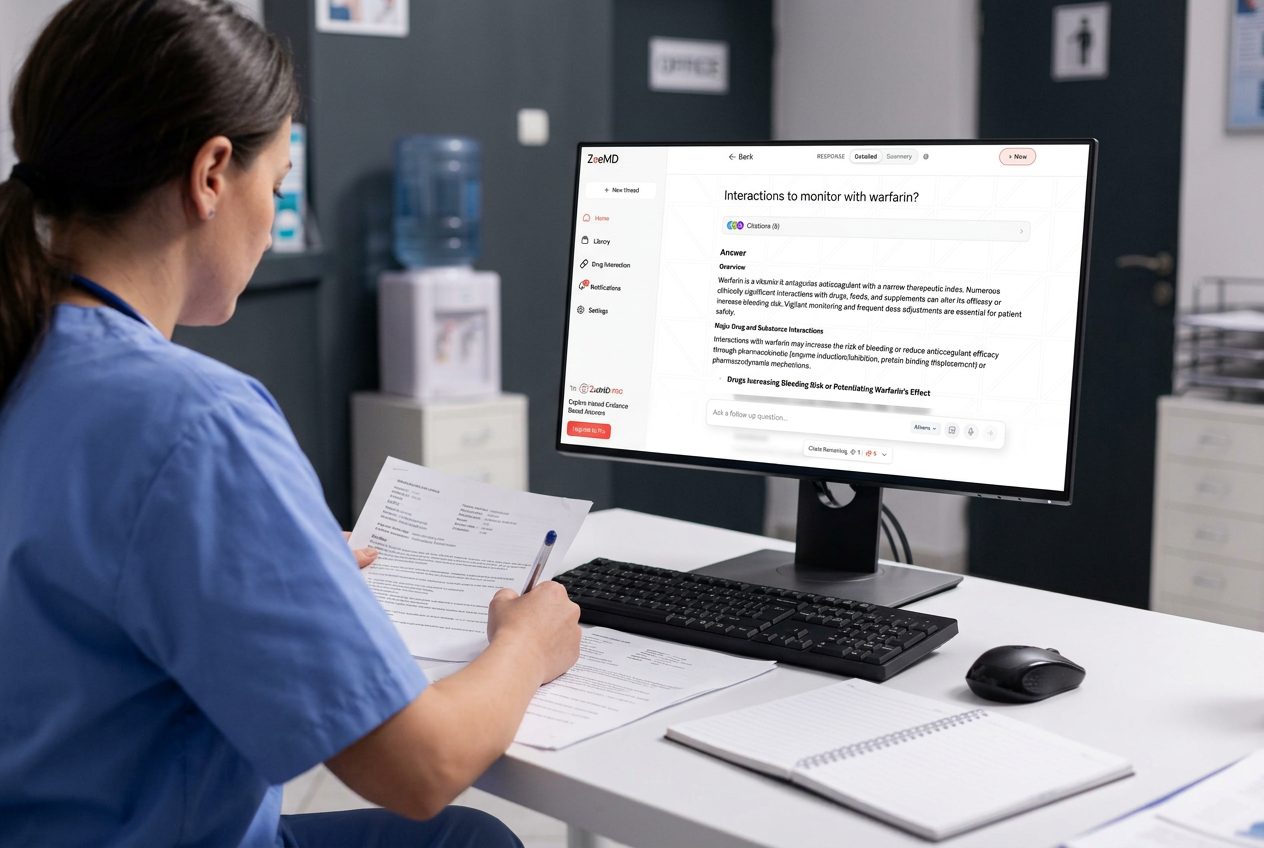
An AI medical assistant with citations is a clinical research tool that answers medical questions while showing the sources behind the answer. For clinicians, the citation layer matters as much as the answer itself. A fluent response can still be incomplete, outdated, or too confident. A cited response gives the clinician a way to verify the reasoning before using it in practice.
This guide explains what doctors, nurses, medical students, and healthcare teams should look for when evaluating a citation-backed medical AI assistant. The goal is not to replace clinical judgment. The goal is to help clinicians find relevant evidence faster, review source links more efficiently, and make better-informed decisions within their own professional workflow.
Quick Answer
The best AI medical assistant with citations should provide clear answers, link to relevant medical sources, separate evidence from interpretation, show when information may be uncertain, and make it easy for clinicians to check the original source. It should support clinical reasoning, not make unsupervised decisions.

Key Takeaways
- Clinicians should judge medical AI by verifiability, not only by how fluent the answer sounds.
- Useful citations should be relevant, current, clickable, and tied to specific clinical claims.
- AI-generated answers should be treated as evidence support, not final medical advice.
- The safest workflow is to ask a focused question, read the answer, open the citations, and apply clinical judgment.
What Is an AI Medical Assistant With Citations?
An AI medical assistant is software that lets users ask health or medical questions in natural language. A citation-backed AI medical assistant goes one step further by attaching source references to the answer. Those references may include clinical guidelines, peer-reviewed research, drug information, medical databases, review articles, or other professional sources depending on the product.
For a clinician, this is different from a general chatbot. A general chatbot may produce a confident summary without showing where each claim came from. A medical AI assistant with citations should make the evidence visible, so the user can ask: Where did this statement come from? Is this source current? Does it apply to my patient or clinical question?
Why Citations Matter in Clinical AI
Medical decisions depend on context. The same diagnosis, treatment option, or guideline summary can change based on age, pregnancy status, comorbidities, local protocols, medication history, allergy risk, renal function, and many other details. Because of that, clinicians need more than a short AI-generated answer. They need traceability.
Citations help solve three important problems in medical AI: verification, trust, and clinical fit.
- Verification: The clinician can open the source and check whether the AI represented it correctly.
- Trust: A cited answer is easier to evaluate than an answer that only sounds authoritative.
- Clinical fit: The clinician can decide whether the source applies to the actual clinical setting.
This is especially important in evidence-based medicine. A useful AI assistant should not hide the evidence. It should help the clinician reach it faster.
What Good Medical Citations Should Show
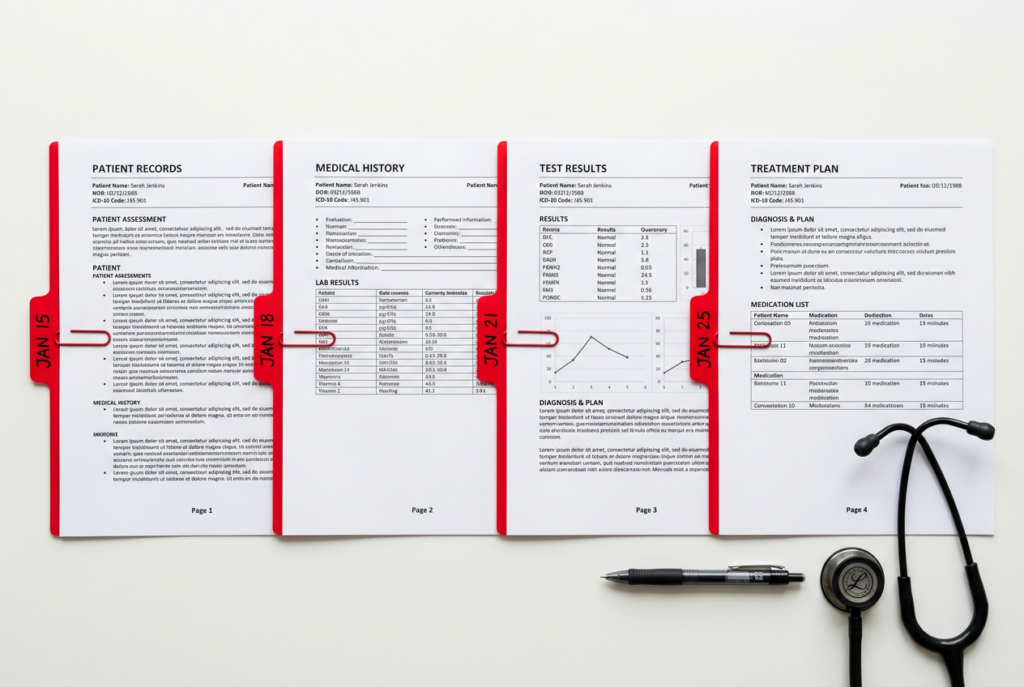
Not all citations are equally useful. A page can technically include references and still fail to support the clinical answer. When reviewing an AI medical assistant, look for citations that are relevant, accessible, current, and specific.
| Citation feature | What to look for | Why it matters |
|---|---|---|
| Source relevance | The source directly supports the claim being made. | Prevents unrelated references from creating false confidence. |
| Source quality | The answer links to guidelines, peer-reviewed literature, or trusted medical references when available. | Clinical questions need stronger evidence than generic web content. |
| Date awareness | The answer makes it possible to check publication or guideline update dates. | Outdated guidance can create clinical risk. |
| Clickable links | The user can open and review the original source. | Clinicians should not rely on summaries alone. |
| Claim-level support | Important recommendations are tied to specific citations. | A citation list at the end is less useful if it is unclear which claim it supports. |
Red Flags in Citation-Backed Medical AI
A medical AI tool can look impressive while still creating risk. Watch for these warning signs:
- The answer includes citations, but the links do not support the specific claim.
- The tool cites old studies without acknowledging newer guidance.
- The answer gives a treatment recommendation without explaining uncertainty or context.
- The tool does not separate general information from patient-specific advice.
- The tool sounds certain even when evidence is limited.
- The citations point only to broad webpages instead of specific papers, guidelines, or source documents.
- The answer does not remind the user to apply local protocols and professional judgment.

How Clinicians Can Verify an AI-Generated Medical Answer
Clinicians do not need to manually redo every search from scratch, but they should use a simple verification workflow before relying on an AI-generated answer.
- Check the exact clinical question. Make sure the AI answered the question you actually asked, not a broader or easier version.
- Open the top citations. Confirm that the source supports the main clinical claim.
- Check dates and context. Look for guideline updates, population differences, and setting differences.
- Identify decision-critical claims. Pay extra attention to dosing, contraindications, red flags, diagnostic criteria, and escalation steps.
- Apply clinical judgment. Use the answer as evidence support, not as an autonomous decision-maker.
Where a Citation-Backed AI Assistant Helps Most
A citation-backed AI medical assistant can be useful when clinicians need a faster path into the evidence. Common use cases include:
- Finding current evidence for a clinical question.
- Reviewing guideline-based management options.
- Comparing possible explanations for a clinical problem.
- Preparing for a literature review or teaching discussion.
- Checking whether a medical claim is supported by sources.
- Summarizing research in plain language before reading the original paper.
The strongest use case is not blind acceptance. The strongest use case is faster evidence discovery with source review.
For clinicians comparing different evidence tools, ZoeMD also has related resources on AI clinical decision support, AI medical search engines, and medical research AI.
Where Clinicians Should Be Careful
Medical AI should not be used as a substitute for patient evaluation, local protocols, specialist input, or professional accountability. It should also not be used to enter identifiable patient information unless the organization has approved the tool, reviewed privacy requirements, and confirmed the correct workflow.
For high-risk decisions, clinicians should verify the source material directly and follow local clinical governance rules.
How ZoeMD Fits
ZoeMD is designed for evidence-based medical questions where clinicians want concise answers with source links they can review. The platform can support clinical research, guideline review, and medical question answering, while keeping the clinician in control of interpretation and final decisions.
A good way to think about ZoeMD is this: it should help shorten the path from question to evidence. It should not remove the need to read, verify, and apply that evidence responsibly.
FAQ
What is an AI medical assistant with citations?
It is an AI tool that answers medical questions and provides source references so clinicians can review the evidence behind the answer.
Are citations enough to trust a medical AI answer?
No. Citations help, but clinicians still need to check whether the source is relevant, current, and correctly interpreted.
Can medical AI replace clinical judgment?
No. Medical AI should support evidence review and clinical reasoning. It should not replace professional judgment, patient evaluation, or local protocols.
What should clinicians check first in a cited AI answer?
Start by checking the main citation behind the most important clinical claim. Confirm that the source actually supports the answer.