

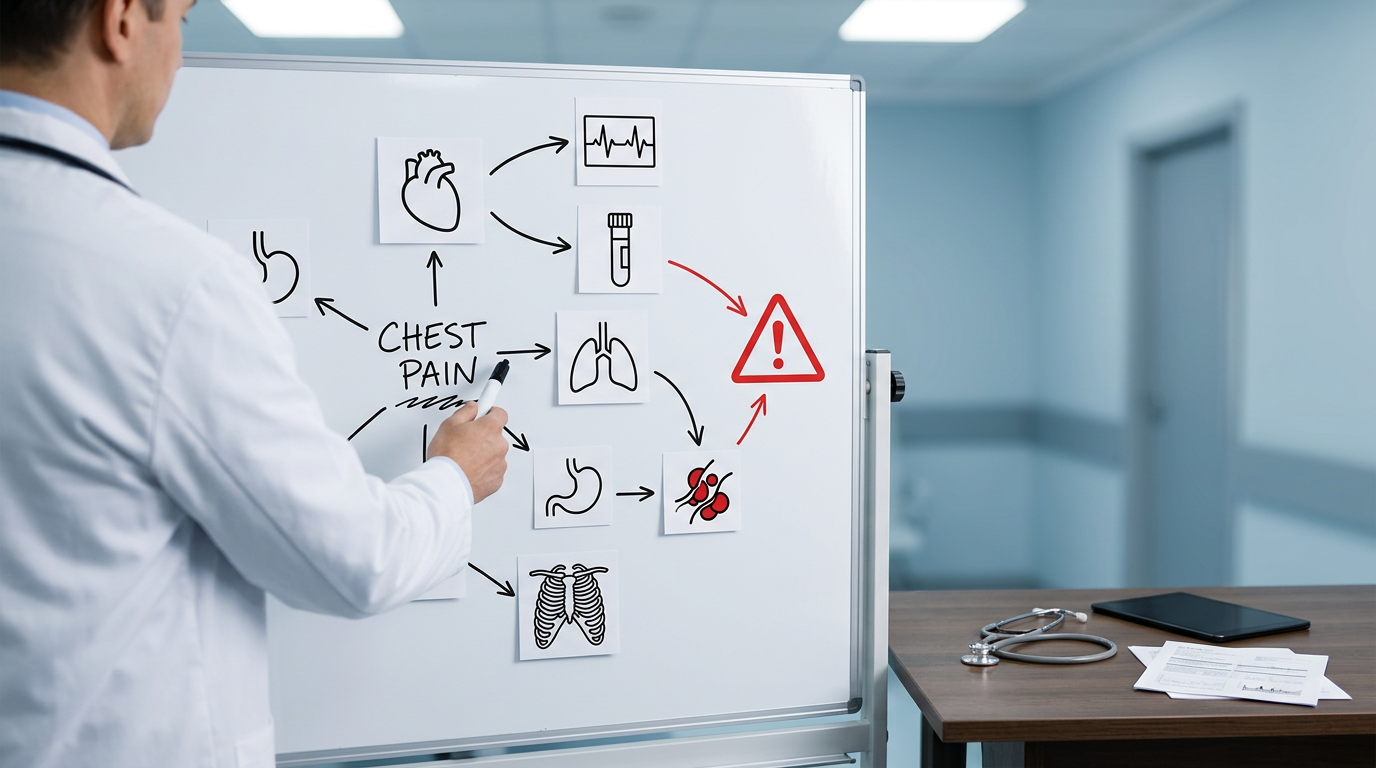
AI medical diagnosis support refers to tools that help clinicians organize diagnostic possibilities, review evidence, identify red flags, and think through clinical uncertainty. Used well, it can support a broader differential diagnosis and faster evidence review. Used poorly, it can create false confidence or reinforce an early diagnostic assumption.
The safest framing is simple: AI can support diagnostic reasoning, but it cannot diagnose a patient on its own. Diagnosis still depends on history, physical examination, testing, clinical context, follow-up, and professional judgment.
Quick Answer
Clinicians can use AI medical diagnosis support safely by entering a focused, de-identified clinical question, asking for differential diagnoses and red flags, reviewing cited evidence, checking patient-specific limitations, and using the output as a reasoning aid rather than a final diagnosis.
Key Takeaways
- AI diagnosis support is best used to broaden thinking, not to replace clinical judgment.
- The highest-value use cases are differential diagnosis, red-flag review, guideline review, and evidence orientation.
- Clinicians should verify cited sources and compare AI output against the actual history, exam, tests, and local protocols.
- A dangerous AI output is not always obviously wrong. It may be incomplete, overconfident, or too generic for the patient.

Why Diagnosis Support Matters
Diagnostic error is a major patient-safety concern. The National Academies has emphasized that many people are likely to experience a diagnostic error in their lifetime, and AHRQ patient-safety resources describe missed, delayed, or wrong diagnoses as a persistent quality problem. AI tools cannot solve that problem alone, but they may help clinicians slow down cognitively, consider alternatives, and look up evidence faster.
That makes AI medical diagnosis support most useful as a second look. It can ask: What else could this be? What dangerous diagnoses should not be missed? What evidence or guideline should I review next?
What AI Diagnosis Support Can Do
| Use case | How AI can help | Clinician responsibility |
|---|---|---|
| Differential diagnosis | Generate possibilities based on symptoms, history, and clinical context. | Decide which possibilities are plausible and what data are missing. |
| Red-flag review | Surface dangerous alternatives or escalation triggers. | Assess urgency using the actual patient presentation and local pathways. |
| Evidence review | Summarize guidelines, review articles, or studies relevant to a question. | Open the sources and confirm the evidence supports the claim. |
| Diagnostic criteria | Organize criteria or testing logic for a condition. | Verify current criteria and apply them to the patient. |
| Patient education draft | Help translate general concepts into plain language. | Adapt the explanation and avoid unsupported personalized advice. |
Where Clinicians Should Be Careful
The main risk is not only that AI may be wrong. It is that AI may be persuasive while being incomplete. A tool may rank a diagnosis too confidently, miss a rare but serious condition, overlook medication or pregnancy context, or summarize evidence without enough nuance.
- Do not rely on AI output without matching it against the actual patient history and examination.
- Do not use a generic AI answer as a substitute for urgent evaluation or escalation.
- Do not enter identifiable patient information unless the tool and workflow have been approved for that use.
- Do not treat a ranked differential as a probability model unless the tool explicitly provides validated probabilities.
- Do not let AI close the differential too early. Use it to keep diagnostic reasoning open.

A Safe Workflow for AI Diagnosis Support
- Start with a focused clinical question. Include relevant de-identified context such as age range, sex when clinically relevant, key symptoms, duration, major comorbidities, medication class, and setting.
- Ask for a differential, not a final answer. Request common, serious, and easily missed possibilities.
- Ask what information would change the differential. This helps identify missing history, exam findings, labs, imaging, or follow-up questions.
- Review red flags and escalation triggers. Compare them with local emergency, referral, and specialty pathways.
- Verify citations for decision-critical claims. Open the source behind diagnostic criteria, treatment thresholds, or urgent recommendations.
- Apply clinical judgment. The clinician decides what fits the patient, what needs testing, and when to seek specialist input.
Example Prompt Patterns
Clinicians should avoid entering identifiable patient information unless the product and organization permit that workflow. These de-identified prompt patterns can help structure safer questions:
- Adult outpatient with subacute dyspnea and history of COPD and heart failure: what broad differential and red flags should I consider?
- What current guideline sources should I review for suspected community-acquired pneumonia in an adult outpatient?
- What dangerous diagnoses can present with acute back pain and neurologic symptoms?
- What clinical features help distinguish migraine with aura from TIA in an adult patient?
- What evidence should I review before choosing first-line therapy for newly diagnosed type 2 diabetes?
How ZoeMD Fits

ZoeMD can support diagnostic reasoning by helping clinicians ask medical questions and review source-linked answers. Its best role is evidence support: helping clinicians move faster from a clinical question to relevant sources while keeping professional judgment in control.
Related ZoeMD resources include AI for differential diagnosis, AI symptom checker for clinicians, and medical AI hallucination verification.
FAQ
Can AI diagnose patients?
AI can support diagnostic reasoning, but it should not independently diagnose patients. Diagnosis requires clinician evaluation, context, testing, follow-up, and professional accountability.
What is AI medical diagnosis support best used for?
It is best used for broadening a differential diagnosis, checking red flags, finding relevant evidence, and organizing clinical reasoning.
Can AI reduce diagnostic error?
AI may help clinicians consider alternatives and review evidence faster, but reducing diagnostic error also requires strong clinical workflows, communication, follow-up, and safety systems.
What makes AI diagnosis support risky?
Risk increases when AI output is treated as a final answer, when citations are not checked, when patient context is incomplete, or when urgent red flags are missed.
Should clinicians enter patient details into AI tools?
Clinicians should follow organizational privacy rules and only enter identifiable patient information into tools approved for that use.
Medical Disclaimer
This article is for informational and educational purposes only. It is not medical advice and does not replace professional clinical judgment, diagnosis, treatment, local protocols, emergency care, or specialist consultation.