Differential diagnosis is one of the most demanding parts of clinical care. Clinicians must synthesize history, examination, risk factors, medications, prior records, and evolving probabilities under time pressure.
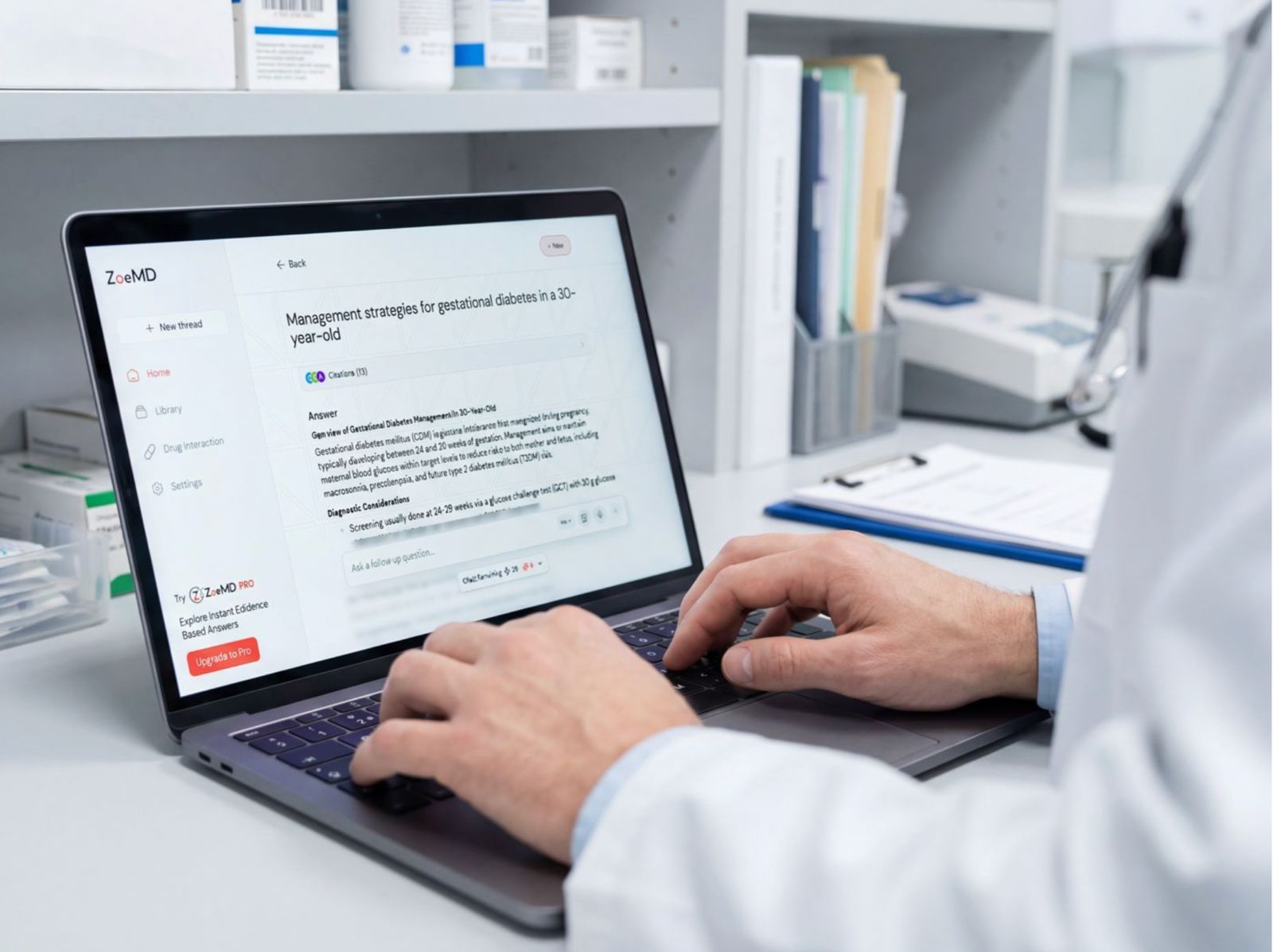
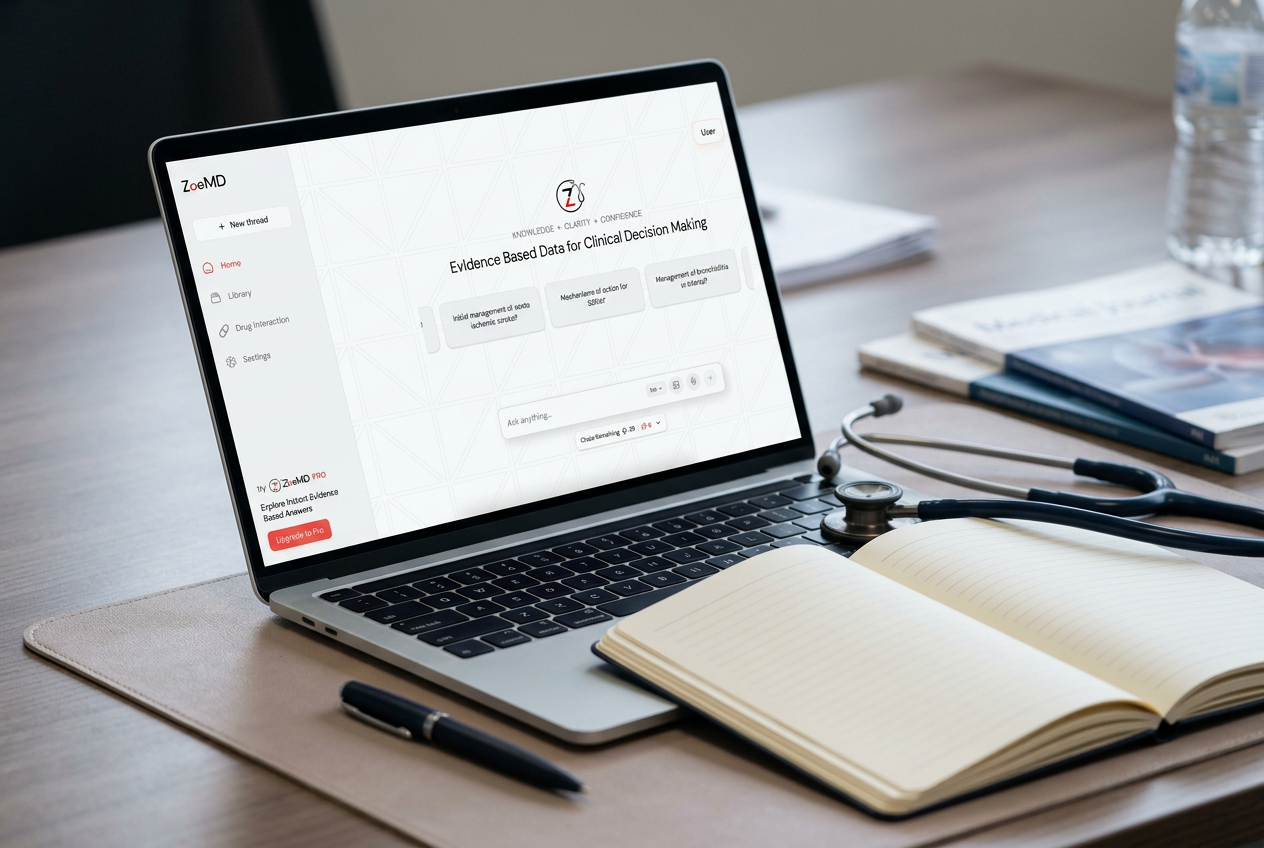
This is where ZoeMD is relevant. In differential diagnosis, clinicians rarely need a tool that simply outputs an answer. They need help comparing possibilities, checking what may have been missed, and reviewing evidence quickly while keeping final judgment in human hands.
Used appropriately, AI can help broaden the differential, highlight red flags, and retrieve evidence. Used poorly, it can reinforce anchoring, create false confidence, or present unsupported reasoning too persuasively.
Written by: ZoeMD Editorial Team
Medically reviewed by: Dr. Chinedu Nwangwu, MD
Published: March 14, 2026
Last updated: March 27, 2026
Reviewed on: March 27, 2026
Reading time: 6 min read
Why trust this: Medically reviewed for clinical accuracy, workflow realism, and patient safety considerations. This article is written for healthcare professionals evaluating how AI can support differential diagnosis without displacing clinician reasoning.
Medical disclaimer: This article is for informational purposes and does not provide medical advice. Clinicians should follow local regulations, institutional policies, and clinical judgment.
Quick Summary
- AI for differential diagnosis works best as clinical support, not as a replacement for physician judgment.
- Its main value is broadening possibilities, surfacing red flags, and speeding up evidence review.
- ZoeMD is most relevant when clinicians need to compare likely explanations and inspect supporting evidence quickly.
- High-risk and ambiguous cases still require especially careful human review.
- The safest tools are transparent, evidence-linked, and easy for clinicians to challenge or refine.
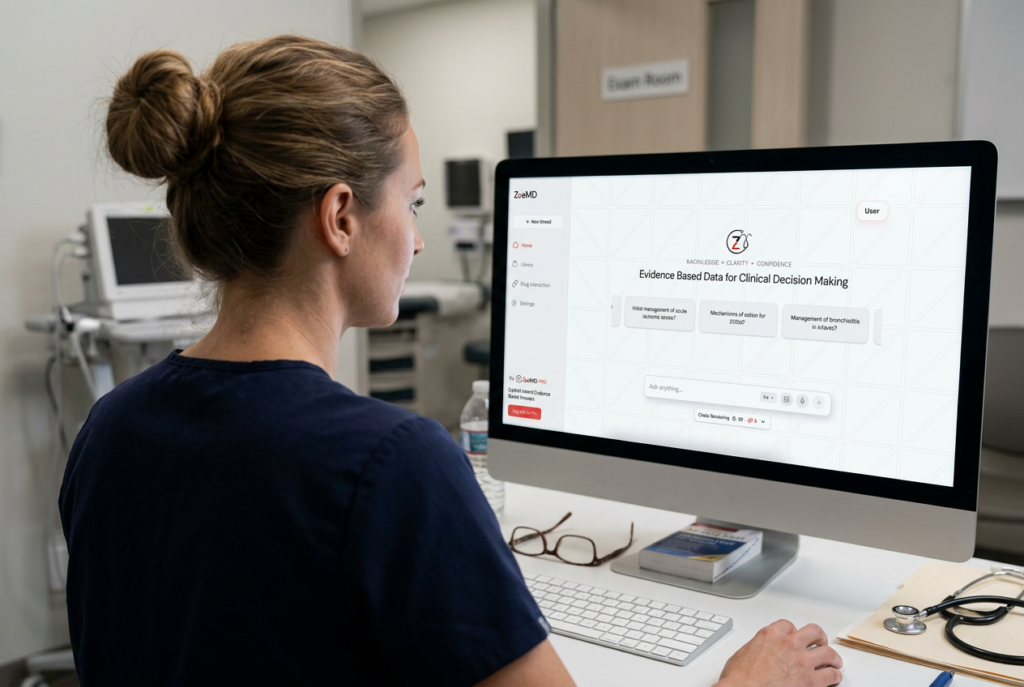
How ZoeMD relates to differential diagnosis
ZoeMD fits this topic because differential diagnosis is not just about generating a list of conditions. It is about thinking through a case more thoroughly and efficiently.
In practice, ZoeMD can help clinicians:
- compare likely and less-obvious diagnostic possibilities
- structure follow-up clinical questions
- retrieve evidence related to competing diagnoses
- review symptom patterns in a more organized way
- sense-check an initial impression against other reasonable explanations
That makes ZoeMD most useful as an evidence-backed clinical reasoning aid, not as an autonomous diagnostic decision-maker.
What AI for differential diagnosis actually means
A safer definition of AI for differential diagnosis is not “a tool that figures out what the patient has,” but a support function that helps clinicians organize possibilities, identify missing considerations, retrieve evidence, and compare explanations against the available data.
That matters because differential diagnosis is contextual. The same presentation can mean very different things depending on age, pregnancy status, immunocompromise, medications, setting of care, and what has already been ruled out.
A useful AI system can support clinicians by helping them:
- generate a broader initial differential
- identify can’t-miss diagnoses
- compare competing explanations
- suggest targeted next-step questions or tests
- retrieve source material for verification
Why this matters in practice
Diagnostic error remains an important patient safety issue. In everyday care, clinicians work under constraints that increase the risk of missed possibilities: limited time, fragmented records, interrupted reasoning, multimorbidity, and cognitive bias such as anchoring or premature closure.
This is why interest in AI-assisted differential diagnosis has grown. The realistic promise is not perfection. It is support: a second pass on the case, a prompt to reconsider alternatives, and faster access to evidence at the point of care.

What AI can help with
1. Broadening the initial differential
AI can help clinicians look beyond the first likely explanation, especially in nonspecific presentations such as fatigue, dyspnea, chest pain, abdominal pain, rash, or dizziness.
2. Highlighting red flags
A strong tool should not only suggest common diagnoses. It should also surface dangerous alternatives that require escalation, urgent workup, or immediate exclusion.
3. Suggesting next-step questions and workup
Useful systems may help identify which history details, exam findings, labs, or imaging pathways would most change diagnostic probability.
4. Retrieving evidence instead of relying on memory
This is one of the clearest ways ZoeMD connects to differential diagnosis. When clinicians are comparing multiple explanations, ZoeMD can help move from a broad question to a focused evidence review more efficiently.
Related ZoeMD resources include AI for Medical Research: When It Helps and When It Doesn’t, Medical Research Assistant AI: Turning Evidence Into Clinical Insight, and AI Symptom Checker for Clinicians: From Symptom Input to Evidence-Based Reasoning.
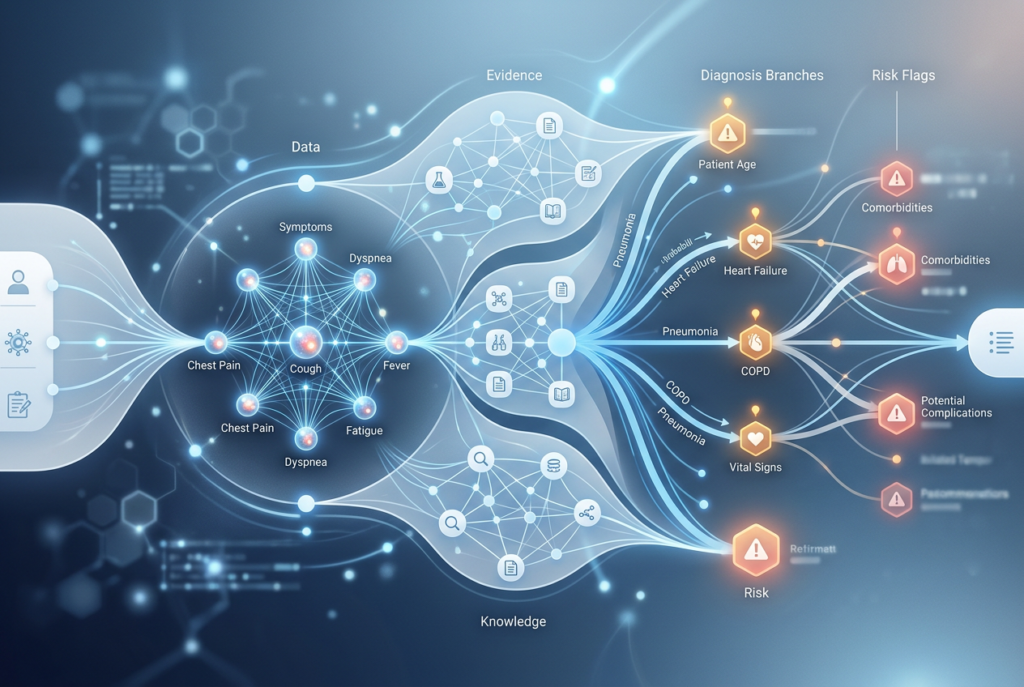
What AI should not do
AI should not be treated as the final decision-maker for diagnosis. It should not replace clinical examination, contextual judgment, or source verification in consequential decisions.
Model performance in case-style testing does not automatically mean safer physician use in real practice. Recent research has shown that access to a large language model alone does not necessarily improve physician diagnostic reasoning performance.
A practical checklist for safe use
| Step | What to do | Why it matters |
|---|---|---|
| Define the case clearly | Include symptoms, timeline, comorbidities, medications, and key negatives | Better input improves output |
| Ask for alternatives | Request a broad differential and can’t-miss diagnoses | Helps reduce premature closure |
| Check the evidence | Review linked guidelines or literature | Fluency is not the same as accuracy |
| Compare, do not copy | Use AI to test reasoning, not replace it | Preserves clinical judgment |
| Verify before acting | Cross-check management-changing claims | High-stakes decisions need review |
Clinical workflow reality
In practice, differential diagnosis unfolds before, during, and after the visit. Clinicians review prior records, gather history and exam findings, place orders, document reasoning, and reassess once test results return.
This is where AI can help without taking control. For example, an internist evaluating fatigue, weight loss, and dyspnea may use ZoeMD to organize possibilities, flag concerning combinations, and identify what information would most influence the next step.
But clinicians still need to stay in charge. Errors usually happen when details are missing, the wrong frame is adopted too early, or the tool sounds more confident than the evidence behind it. In real workflow, clinicians care about source visibility, edit control, privacy, and auditability far more than impressive-sounding output.

Limitations, risks, and when to be cautious
AI can be wrong in believable ways. It may omit an important diagnosis, overstate weak evidence, or reinforce the wrong frame if the input is incomplete.
Extra caution is warranted in:
- unstable or rapidly deteriorating patients
- high-acuity emergency presentations
- immunocompromised or medically complex patients
- pregnancy-related or pediatric cases
- situations where rare but dangerous diagnoses must be actively excluded
Clinicians and organizations should also understand how data are handled, retained, and reviewed. Governance and transparency are part of safe adoption.
How clinicians should evaluate an AI differential diagnosis tool
Ask these questions:
- Does it show evidence or source material?
- Does it preserve clinician control?
- Is the output editable and reviewable?
- Does it fit real point-of-care workflow?
- Are privacy and audit features clear?
Differential diagnosis also overlaps with adjacent clinical AI workflows, including What Is an AI Medical Assistant? A Guide for Clinicians in 2026 and AI Symptom Checker for Clinicians.
Where ZoeMD fits
ZoeMD is not best understood as a diagnosis bot. It is more accurately an evidence-oriented clinical support layer that helps clinicians explore possibilities, pressure-test an initial impression, and retrieve supporting information more efficiently.
A practical way to think about it is this: ZoeMD is useful when a clinician is asking, “What else should I be considering, and what evidence supports or weakens each possibility?” That is where it can support differential diagnosis without replacing clinical judgment.
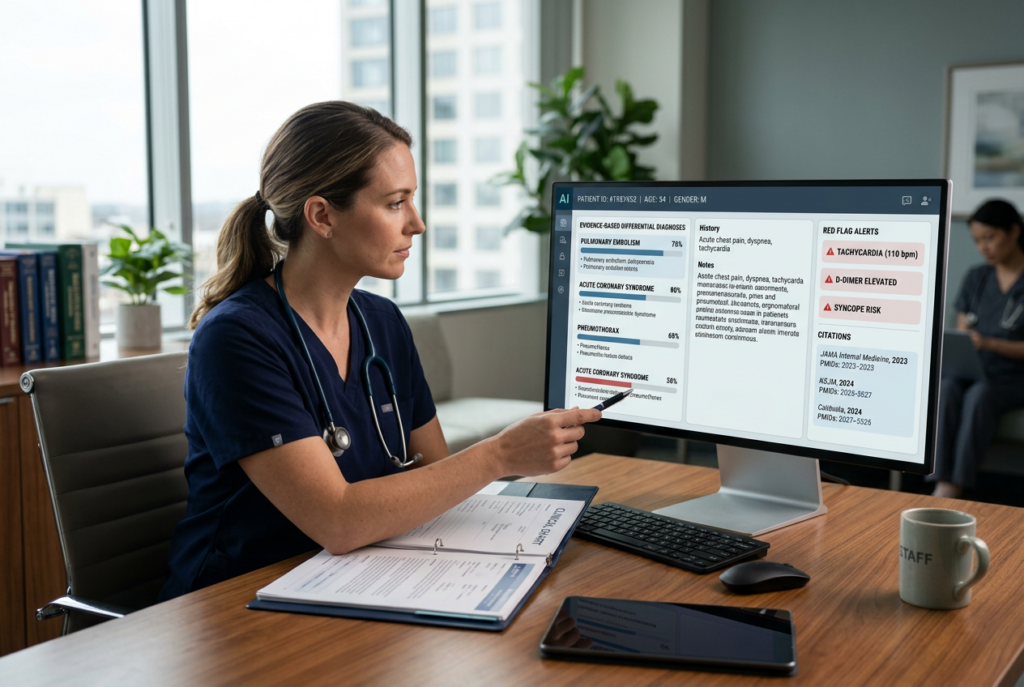
Final thoughts
AI for differential diagnosis is most valuable when it supports clearer reasoning rather than pretending to deliver certainty. The right role is to widen thinking, expose evidence, and help clinicians revisit alternatives that matter.
The best use case is not diagnosis by automation. It is diagnosis with better support.
If your team is evaluating evidence-based AI to support differential diagnosis while preserving clinician control, ZoeMD can be explored as part of that workflow.
FAQ
1. Can AI make the final diagnosis for a clinician?
No. AI should be treated as decision support, not as the final diagnostic authority.
2. What is the safest use of AI in differential diagnosis?
Using it to broaden the differential, identify red flags, and retrieve evidence for review.
3. Does AI reduce diagnostic error?
It may help in some workflows, but benefits depend on design, evidence transparency, and clinician review.
4. What should clinicians verify before using an AI suggestion?
The case summary, evidence quality, omitted alternatives, and whether the suggestion fits the patient’s actual risk profile.
5. When should clinicians be especially cautious?
In unstable patients, complex multisystem disease, pediatric or pregnancy-related presentations, and any case where a missed diagnosis could cause rapid harm.
6. Is a symptom checker the same as differential diagnosis support?
No. Symptom checkers may help structure input, while differential diagnosis support goes further by comparing competing explanations and surfacing evidence.
7. What makes one tool more trustworthy than another?
Source transparency, review control, privacy clarity, auditability, and realistic claims.
8. Should clinicians document that AI was used?
That depends on policy and workflow, but the record should always reflect the clinician’s own reviewed reasoning.
How this article was created
This article was prepared by the ZoeMD Editorial Team and medically reviewed by Dr. Chinedu Nwangwu, MD for clinical accuracy and workflow realism. AI-assisted drafting and editing were used to help organize and update the content, and the final article was shaped to reflect current clinical AI guidance and diagnostic safety considerations.
Evidence & Sources
- National Academies of Sciences, Engineering, and Medicine. Improving Diagnosis in Health Care. Washington, DC: National Academies Press; 2015.
- World Health Organization. Patient Safety fact sheet. Updated September 11, 2023.
- Agency for Healthcare Research and Quality (AHRQ) PSNet. Diagnostic Errors.
- Goh E, et al. Large Language Model Influence on Diagnostic Reasoning: A Randomized Clinical Trial. JAMA Network Open. 2024;7(12):e2440969.
- Eriksen AV, et al. Use of GPT-4 to Diagnose Complex Clinical Cases. NEJM AI. 2024.
- Agency for Healthcare Research and Quality (AHRQ). Clinical Decision Support.
- U.S. Food and Drug Administration. Clinical Decision Support Software: Guidance for Industry and Food and Drug Administration Staff. January 2026.
- American Medical Association. Augmented Intelligence in Medicine. Updated March 13, 2026.
- Norman GR, Eva KW. Diagnostic error and clinical reasoning. Medical Education. 2010;44(1):94-100.
- Staal J, et al. Effect on diagnostic accuracy of cognitive reasoning tools for support of clinicians: a systematic review and meta-analysis. BMJ Quality & Safety. 2022;31(12):899-912.