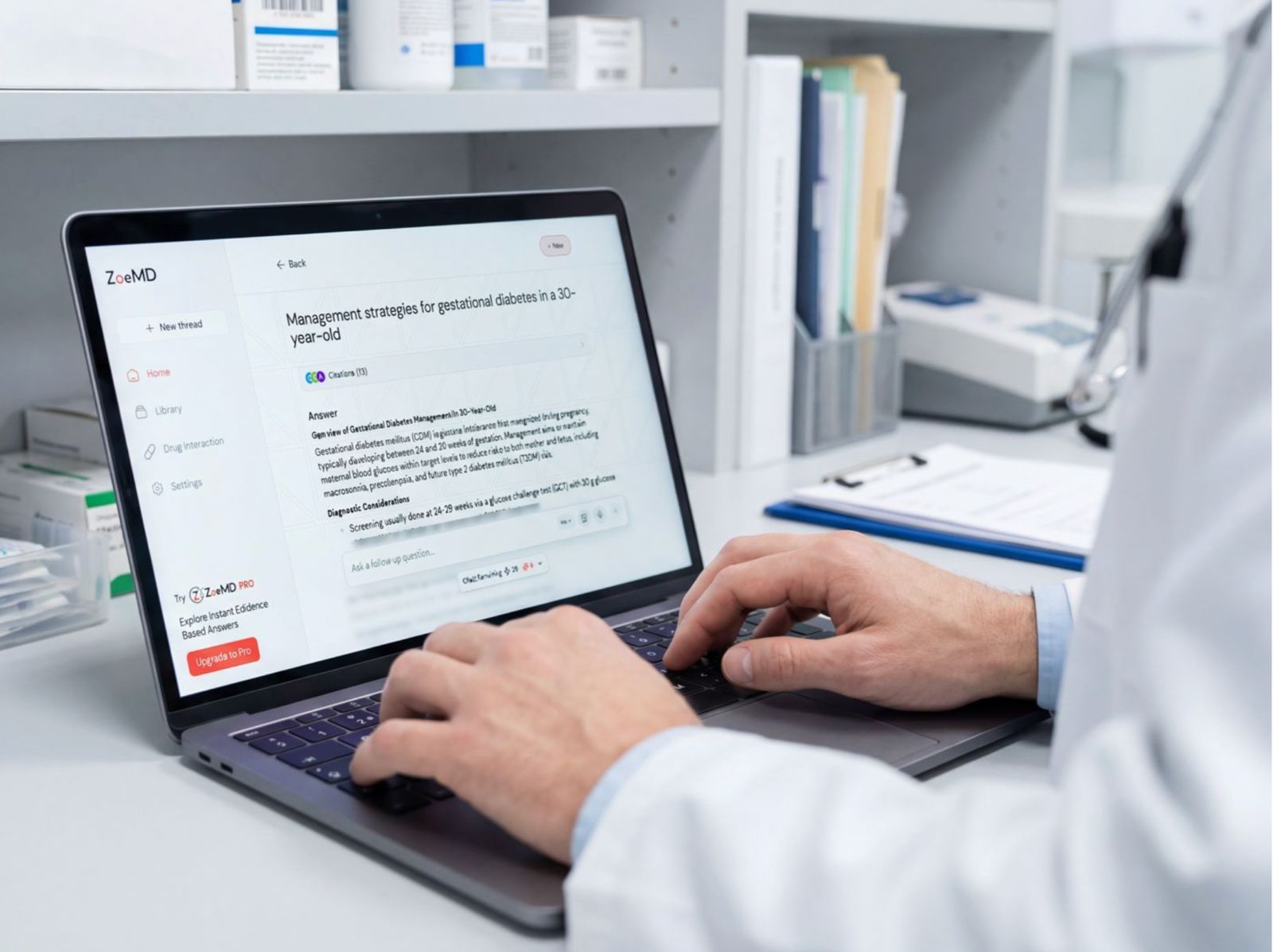

At the point of care, clinicians usually do not need more information. They need the right information, fast.
That is why a useful AI clinical protocol library should do more than surface generic summaries. It should help clinicians find protocol-related information quickly, understand the reasoning behind it, and review the source context before acting.
For related reading, see AI Clinical Decision Support, Medical Research AI, and the ZoeMD homepage.

What clinicians actually need
A point-of-care protocol tool should help clinicians do five things well.
1. Find the right protocol question quickly
In real practice, the question is usually specific. It is not “show me the full guideline.” It is closer to:
- What should I review in suspected sepsis?
- What are the key considerations in suspected ACS?
- What matters most in an acute stroke evaluation?
- What should I check before escalating care?
A useful tool should let clinicians ask these questions in natural language and get to the relevant part faster.
2. Give a clear answer without losing the evidence
Clinicians do not need long, abstract explanations during busy care. They need concise answers that are still grounded in evidence.
That means the output should be readable, clinically relevant, and tied to source material where possible.

3. Keep patient context in view
Protocols standardize care, but patients do not arrive as perfect protocol examples.
A good workflow should still leave room for:
- comorbidities
- organ function
- medication profile
- contraindications
- severity of presentation
- when escalation or specialist input is needed
4. Help the clinician go deeper when needed
Sometimes a quick answer is enough. Sometimes it is not.
A strong protocol-support workflow should make it easier to move from a concise answer to deeper review of supporting evidence, related guidance, or a cited source.
5. Stay within clear limits
No AI tool should be treated as a replacement for local pathways, order sets, pharmacist review, specialist consultation, or bedside judgment.
That is especially important in unstable, atypical, or high-risk cases.

How ZoeMD fits this scenario
ZoeMD is best used here as a medical AI chat and evidence-support tool. It can help clinicians ask protocol-related questions in natural language, review cited answers, and access broader medical sources more quickly.
In practice, that means ZoeMD may be useful when a clinician wants to:
- clarify a protocol-related question quickly
- review a concise, evidence-backed answer
- check cited supporting material
- compare a patient scenario against broader clinical guidance
- move from a quick answer into deeper evidence review
For example, a clinician might use ZoeMD to ask:
- What should I review in suspected sepsis before escalation?
- What are the core considerations in suspected ACS?
- What should I check in an acute stroke workup?
- What medication issues or contraindications should I keep in mind in this scenario?
This can save time compared with manual searching alone, especially when the goal is to narrow a question quickly and review supporting information in one place.
What ZoeMD should not be used as
ZoeMD should not be treated as:
- a substitute for hospital protocols
- an official order set
- a replacement for pharmacist review
- a replacement for specialist consultation
- a tool that makes the final clinical decision
A safe workflow is not “ask AI and act.” It is ask, review, verify, and apply judgment.

A realistic clinical workflow
A practical way to use ZoeMD at the point of care is:
- Ask a focused protocol-related question.
- Review the summary and cited support.
- Compare the answer with the patient’s presentation, risks, medications, and organ function.
- Confirm alignment with local policy or order sets.
- Escalate when needed.
That is where the value is. ZoeMD can help reduce the time it takes to move from question to evidence review, but it should still sit inside a clinician-led process.
Why weak protocol tools fail
Many tools fall short in predictable ways. They return generic summaries, sound too certain, ignore patient-specific factors, or blur the line between general guidance and local implementation.
That creates friction instead of reducing it.
A clinically useful tool should help a medical professional think more clearly, not simply answer faster.
Bottom line
An AI clinical protocol library should help clinicians find the right information quickly, understand the reasoning behind it, and review supporting evidence without losing sight of patient context.
Used properly, ZoeMD can support that workflow by helping medical professionals ask focused questions, review cited answers, and access relevant medical information more efficiently. It should still be used as decision support, not as a replacement for local protocol authority or clinical judgment.
To learn more, visit the ZoeMD homepage, browse the blog, or contact ZoeMD.
Medical disclaimer: This article is for informational purposes only. Clinicians should use local protocols, approved references, specialist input, and clinical judgment before making treatment decisions.
FAQ
What is an AI clinical protocol library?
An AI clinical protocol library is a tool that helps clinicians retrieve and review protocol-related information using natural language, concise summaries, and supporting sources.
Can ZoeMD replace hospital protocols?
No. ZoeMD can support protocol-related review and evidence retrieval, but it should not replace local hospital pathways, order sets, or clinician judgment.
When is a tool like ZoeMD most useful?
It is most useful when a clinician needs to clarify a focused question quickly, review cited information, and move into deeper evidence review without relying on manual searching alone.
Written by: ZoeMD Editorial Team
Medically reviewed by: Dr. Chinedu Nwangwu, MD
Published: April 21, 2026
Last updated: April 25, 2026