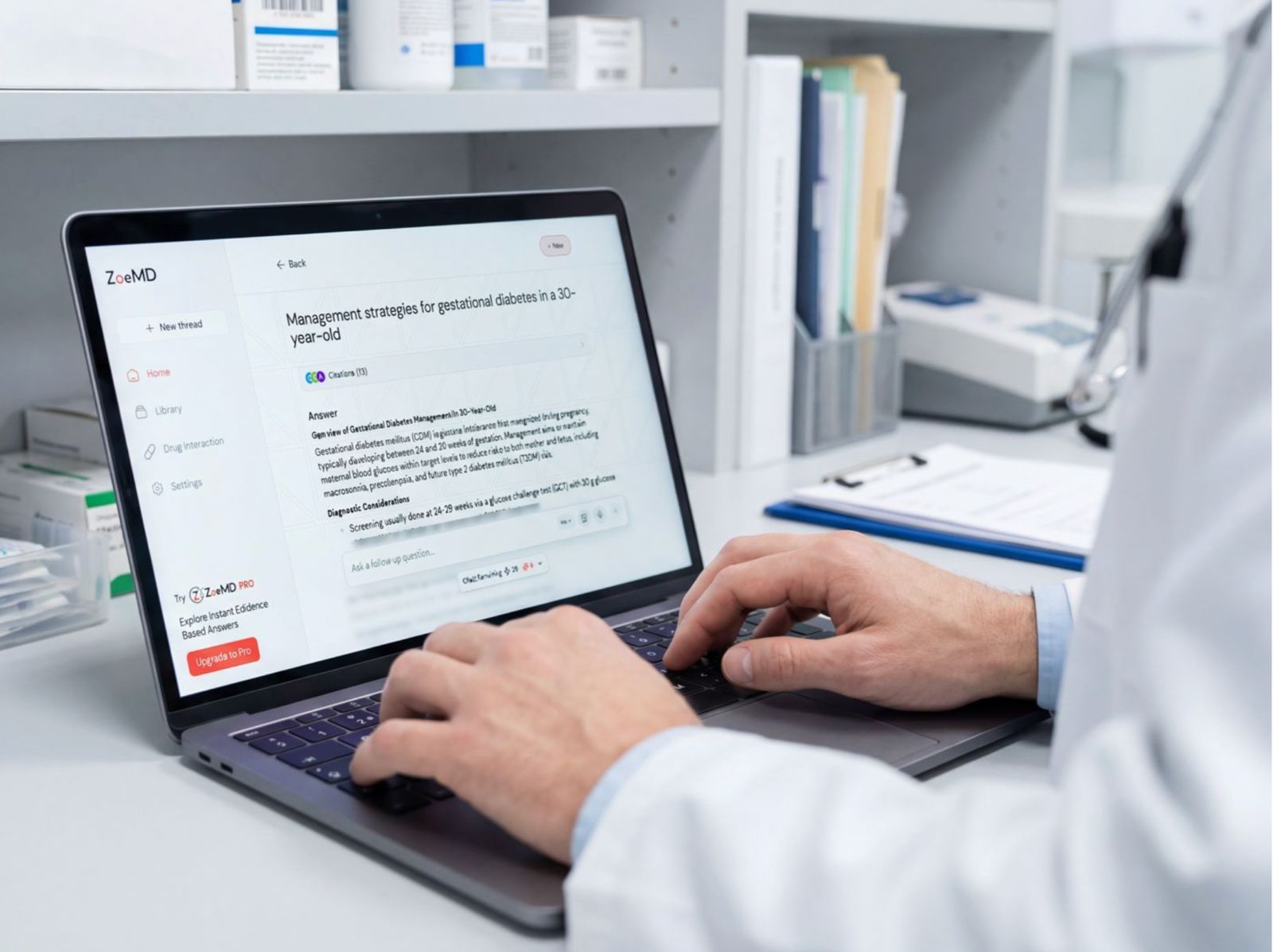


An AI medical search engine finds medical evidence. An AI medical assistant helps a clinician use that evidence to answer a question. The categories overlap, but they are not identical – and the difference matters when evaluating a tool for clinical work.
Quick Answer
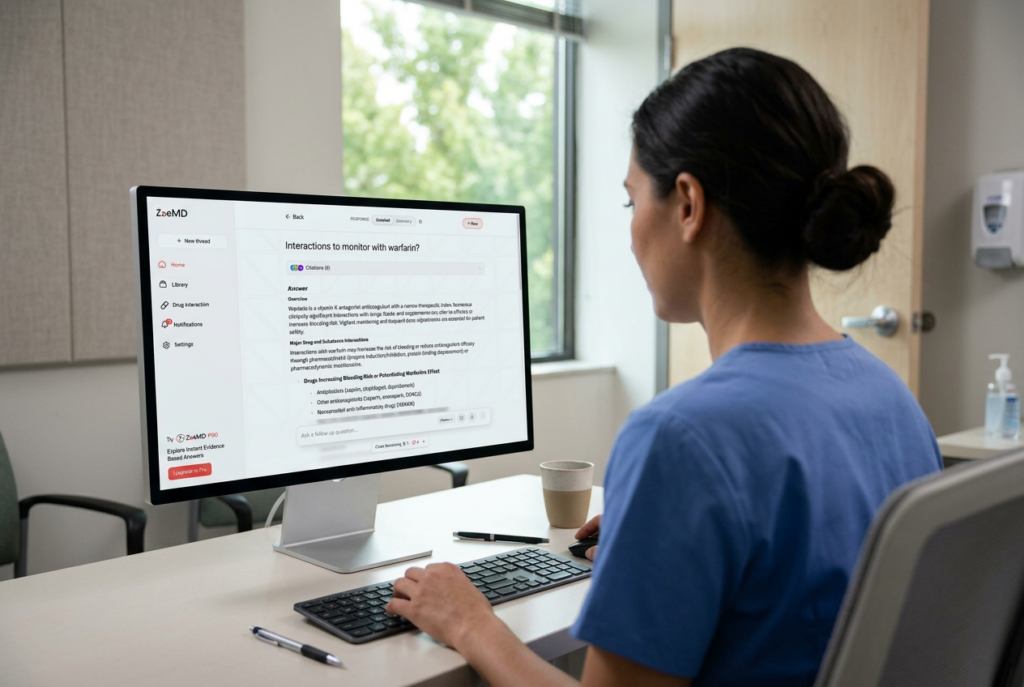
A medical search engine retrieves relevant literature, guidelines, and medical references. An AI medical assistant adds another layer: it interprets the question, organizes the evidence, produces a concise answer, and connects important claims to sources. ZoeMD combines these functions by searching medical evidence and returning cited answers that clinicians can review.
AI Medical Assistant vs AI Medical Search Engine
| Question | AI medical assistant | AI medical search engine |
|---|---|---|
| Primary job | Organize, explain, and synthesize information around a clinical question. | Retrieve relevant papers, guidelines, and other medical sources. |
| Typical input | A natural-language clinical or research question. | Keywords, filters, or a structured search query. |
| Typical output | A concise answer, comparison, or evidence summary with citations. | A ranked list of sources, abstracts, or matching documents. |
| Work left to the clinician | Verify the important claims and decide whether the evidence fits the case. | Open, read, compare, and synthesize the retrieved sources. |
| Main risk | A fluent synthesis may overstate, omit, or misapply evidence. | Relevant evidence may be missed, poorly ranked, or buried in a long result list. |
| Best use | Fast orientation and source-backed answers at the point of care. | Comprehensive discovery and manual evidence review. |
What an AI Medical Search Engine Does
A medical search engine is primarily a retrieval tool. It helps a user find documents that match a question, keyword set, diagnosis, intervention, or evidence category. The output may include journal articles, abstracts, clinical guidelines, drug references, or ranked links.
This is useful when the clinician wants broad coverage or needs to perform the appraisal personally. The tradeoff is time: finding a relevant source is not the same as determining what the combined evidence means.
What an AI Medical Assistant Adds
An AI medical assistant starts with the clinician’s question and helps turn retrieved information into a usable evidence summary. Depending on the tool, it may compare recommendations, identify uncertainty, organize a differential, summarize a guideline, or explain why a source is relevant.
The useful distinction is simple: search returns sources; assistance reduces the work between those sources and a reviewable answer.

Retrieval Is a Capability; Assistance Is a Workflow
This is the part most comparisons miss. A medical assistant does not become trustworthy merely because it can write a fluent answer. Its value depends on the retrieval layer underneath it and on how clearly the answer remains connected to that evidence.
Research on retrieval-augmented medical question answering suggests that adding retrieval and safety filtering can improve accuracy and reduce hallucinations, but it does not eliminate error. In one comparative study, retrieval-based enhancement improved mean accuracy by 13% and reduced hallucinations by a mean of 15.1% across four tested language models. Read the PubMed study.
That means the safest workflow is not search alone or synthesis alone. It is retrieval, cited synthesis, and clinician verification working together.
Where ZoeMD Fits
ZoeMD is best understood as an evidence-focused AI medical assistant with medical search built into the workflow. According to ZoeMD, the platform searches more than 39 million medical sources, including peer-reviewed literature, clinical guidelines, and medical databases. It then returns cited answers with direct links to supporting sources.
The important product is therefore not merely a list of search results. It is a shorter path from a clinical question to a source-backed answer that can still be checked by the clinician.
How Clinicians Should Evaluate Either Tool
- Check the source trail. Can you open the evidence behind the important claims?
- Check exact support. Does the source actually support the statement, or is it only related to the same topic?
- Check clinical fit. Do the population, setting, exclusions, jurisdiction, and publication date match the question?
- Check what is missing. Look for conflicting guidance, contraindications, uncertainty, and evidence gaps.
- Keep judgment in control. Use the tool to support review, not as an autonomous clinical decision-maker.
This principle is consistent with the FDA’s 2026 clinical decision-support guidance, which emphasizes enabling healthcare professionals to independently review the basis of recommendations rather than rely primarily on the software’s output.

Which One Do You Need?
- Choose a search engine when you need broad source discovery, complex filters, or a comprehensive manual review.
- Choose an AI medical assistant when you need a fast, structured answer that remains connected to sources.
- Choose a hybrid workflow when you want conversational speed without losing the ability to inspect the underlying evidence.
Frequently Asked Questions
Is an AI medical assistant the same as a medical search engine?
No. A medical search engine primarily retrieves sources. An AI medical assistant may use search as one component, then organize and explain the retrieved evidence in response to a clinical question.
Can an AI medical assistant replace PubMed or guideline databases?
No. It can reduce search and synthesis time, but clinicians may still need direct database searching, approved drug references, local protocols, and full-text appraisal for high-impact decisions.
Why do direct citations matter?
Direct citations make the answer inspectable. They allow the clinician to confirm that a source exists, supports the exact claim, is current, and applies to the relevant population and setting.
Bottom Line
An AI medical search engine helps clinicians find evidence. An AI medical assistant helps them move from a question to an organized, source-backed answer. ZoeMD combines both ideas: medical evidence retrieval underneath and a cited clinical-answer workflow on top.
Medical Disclaimer
This article is for informational and educational purposes only. It is not medical advice and does not replace patient evaluation, professional clinical judgment, approved references, local protocols, pharmacist review, specialist consultation, or emergency care.