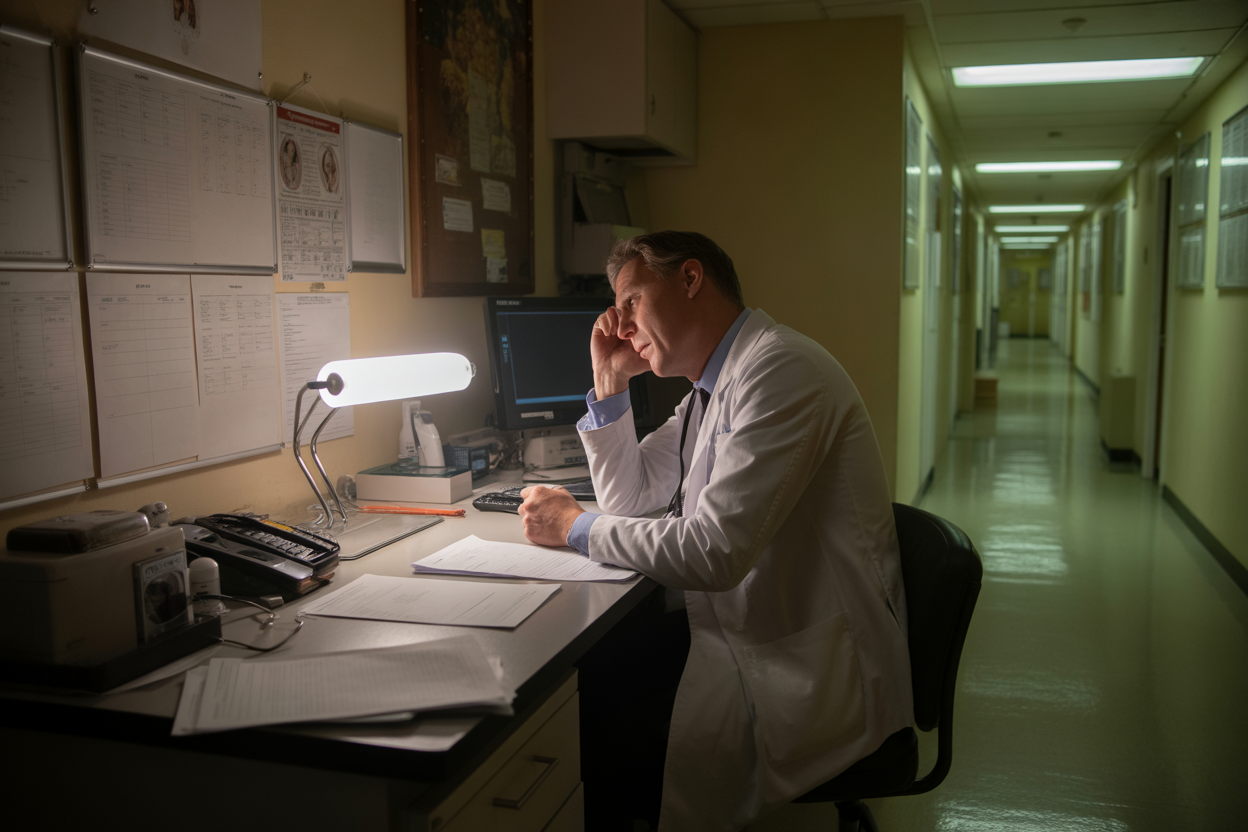
Physician burnout is not a motivation problem—it is a systems problem. When clinical complexity rises while documentation, inbox volume, and guideline churn keep expanding, clinicians lose the one resource they cannot replace: uninterrupted time to think.
In that environment, “physician burnout solutions” that rely solely on resilience strategies are incomplete. What consistently helps is reducing the inputs that drive burnout: administrative burden, after‑hours work (“pajama time”), cognitive overload, and constant information hunting.
AI can be a practical lever—when it removes work instead of adding friction.
This guide outlines evidence‑based, clinician‑friendly strategies to reclaim time and improve care quality. It also explains how ZoeMD fits: an evidence‑based AI chatbot that answers doctors’ clinical questions with clear reasoning and reliable citations—using only what the clinician types plus openly available, verified medical sources. ZoeMD is not an EMR‑connected tool and does not analyze patient data.
Why burnout persists: time pressure + cognitive load
Burnout tends to escalate when clinicians experience a sustained mismatch between:
- Clinical responsibility (high‑stakes decisions, diagnostic uncertainty, guideline adherence)
- Administrative workload (documentation, inbox, forms, coordination)
- Information workload (keeping up with new evidence, reconciling guidelines, verifying criteria)
- Time scarcity (short visits, high patient volume, constant interruptions)
Many physicians can tolerate any one of these pressures for a time. Burnout accelerates when they stack—especially when they push work into evenings and weekends.
The goal of clinical workload AI should be simple:
- Reduce low‑value time cost
- Reduce cognitive burden during decision‑making
- Improve consistency and safety without creating new “tool fatigue”

What “AI to reduce burnout” should look like in real practice
If AI adds more alerts, more clicks, or more uncertainty, it can worsen burnout. The highest‑value time‑saving tools for doctors typically do one of the following:
- Compress research time (find, synthesize, and cite evidence quickly)
- Reduce repetitive work (standardize outputs, templates, reusable workflows)
- Improve clarity (criteria, red flags, pathways presented in a clinician‑friendly structure)
ZoeMD is designed for the research and evidence‑retrieval problem—the time and mental effort of hunting across multiple sources.
What ZoeMD does (and what it does not do)
ZoeMD in one sentence
ZoeMD is an AI chatbot for clinicians that answers medical questions with evidence‑backed, cited responses—helping doctors retrieve and apply reliable research faster.
What ZoeMD helps with
- Summarizing guidelines and translating them into practical clinical takeaways
- Clarifying diagnostic criteria (and differentiating similar conditions)
- Comparing guideline differences across organizations or regions
- Highlighting red flags, contraindications, and safety considerations
- Retrieving and summarizing relevant studies and reviews, with citations
What ZoeMD does not do
- No EMR integration
- No patient record ingestion
- No automated analysis of patient data
ZoeMD uses:
- Clinician input (what the doctor types)
- Openly available, verified medical sources
This keeps the workflow lightweight and physician‑controlled.
Helpful pages:
Evidence‑based strategies to reduce burnout (practical and measurable)
1) Treat after‑hours work as a measurable workflow defect
Many clinicians underestimate how much time slips into evenings.
What to do (7 days):
- Track only two numbers daily:
- Minutes of after‑hours documentation
- Minutes of inbox + coordination
- Add a third number if relevant:
- Minutes spent searching for evidence/guidelines
You do not need perfect measurement. You need a baseline.
Why it matters: You cannot reduce what you do not see—and burnout often hides in “small” daily time leaks that compound.
2) Reduce documentation burden with standardization, not heroics

Documentation is often unavoidable—but variability is optional.
High‑impact changes:
- Standardize note structure (problem‑based A/P, consistent headings)
- Reduce “reinventing the note” for common visit types
- Create two tiers of notes:
- Core note (clinically essential)
- Expanded note (only when clinically or legally necessary)
Principle: The purpose is not to write more. It is to write what is necessary, consistently.
3) Compress evidence hunting into a single step
The “information workload” is a major hidden driver of fatigue:
- Checking diagnostic criteria
- Confirming guideline updates
- Reconciling conflicting recommendations
- Verifying safety/contraindications
In a busy day, these tasks happen repeatedly—often in fragmented minutes between patients.
How to use ZoeMD as a time‑saving tool for doctors:
- Replace multi‑tab searches with one question
- Use the cited answer as a starting point for decision support
- Save the best prompts so you can reuse them

Example prompts (copy/paste templates):
- “Summarize current guideline‑aligned first‑line treatment for [condition] in adults; include contraindications, red flags, and key evidence.”
- “List diagnostic criteria for [condition] and differentiate it from [similar condition]; include key clinical markers.”
- “Compare [Guideline A] vs [Guideline B] recommendations for [topic]; highlight clinically meaningful differences.”
- “What evidence supports [intervention] for [condition]? Provide strength of evidence and key outcomes.”
Why this reduces burnout: It lowers cognitive load and the number of context switches—two major contributors to decision fatigue.
4) Standardize “high‑friction decisions” to reduce decision fatigue
Burnout increases when clinicians repeatedly re‑solve the same uncertainty.
Pick 10 recurring decision points (examples):
- Anticoagulation thresholds
- Antibiotic selection in common scenarios
- Imaging/red‑flag criteria
- Chronic disease targets
- Medication safety constraints
Build a small prompt library in ZoeMD for these. The goal is not to outsource judgment—it is to avoid repeated time‑consuming searching.
5) Use evidence‑based explanations to reduce downstream rework
Many “extra” tasks come from misunderstandings:
- Follow‑up calls
- Clarifying messages
- Patient anxiety driven by conflicting online information
ZoeMD can help generate evidence‑based patient explanations (written in plain language) that you can adapt:
- Risks and benefits
- Rationale for tests
- Shared decision‑making summaries
Outcome: better clarity now, fewer time‑consuming corrections later.
6) Add guardrails so AI reduces risk—without creating extra work
For AI to reduce burnout, it must be safe and predictable.
Practical guardrails:
- Use AI for evidence retrieval and summarization, not final decisions
- Prefer outputs that include citations and transparent reasoning
- Do not include patient identifiers or sensitive details
- For high‑stakes scenarios, verify against primary guidelines or institutional policy
ZoeMD’s evidence‑first approach is designed to fit a “trust but verify” clinical workflow.
How this improves care quality—not just clinician well‑being
Reducing burnout is not only about clinician comfort. It directly affects care:
- More time for clinical reasoning and patient communication
- More consistent guideline alignment
- Fewer errors driven by fatigue or rushed decisions
- Better continuity, fewer missed safety details
In other words, AI to reduce burnout is also an evidence‑based pathway to improving clinical outcomes—when it reduces workload rather than increasing complexity.

Where ZoeMD fits in the ecosystem of clinical workload AI
AI tools in medicine generally fall into categories:
- Documentation automation (reduces note burden)
- Predictive analytics (risk and triage support)
- Evidence retrieval and clinical reasoning support (reduces research time and cognitive load)
ZoeMD is in the third category: evidence‑based research support at the point of decision‑making—powered by clinician input and validated sources, with citations.
If you want to explore how ZoeMD approaches clinical decision support:
- AI Clinical Decision Support (2026)
- Clinical Decision Support Systems (CDSS)
- Evidence Retrieval AI: The Future of Evidence Access
Conclusion: the best burnout strategy is workload reduction
Burnout rarely resolves through willpower alone. The most durable physician burnout solutions reduce the work that overwhelms time and attention.
AI can help—when it is deployed as a time‑saving tool for doctors that:
- reduces evidence‑hunting time,
- reduces cognitive load,
- standardizes high‑friction decisions,
- and improves patient communication without extra friction.
ZoeMD is built to support that goal: a clinician‑first, evidence‑based AI chatbot that answers medical questions quickly and backs outputs with reliable sources—without EMR connectivity and without analyzing patient data.
If you want to try an evidence‑first workflow, start here: