
Artificial intelligence has entered nearly every industry, but in healthcare, expectations are understandably higher. Accuracy matters. Evidence matters. Context matters.
So what exactly is an AI medical assistant in 2026—and how is it different from a chatbot, a search engine, or a traditional clinical decision support system?
For clinicians navigating increasing documentation demands, expanding medical literature, and rising burnout rates, understanding the role of an AI-powered medical assistant is no longer optional. It’s becoming part of modern practice.
This guide explains what an AI medical assistant is, how it works, and how evidence-based systems like ZoeMD are reshaping clinical workflows without replacing professional judgment.
What Is an AI Medical Assistant?
An AI medical assistant is a clinician-focused artificial intelligence system designed to support medical reasoning, evidence retrieval, and structured analysis in clinical settings.
Unlike consumer health apps or symptom checkers for patients, a clinical AI assistant is built for:
- Licensed healthcare professionals
- Evidence-based reasoning
- Context-aware synthesis
- Transparent source grounding
Rather than simply listing documents, an AI medical assistant retrieves relevant medical literature and organizes it into usable, structured insights.
This distinction becomes clearer when compared to an AI medical search engine, which primarily retrieves documents without synthesizing them. ZoeMD explores this difference further in its post on the AI medical search engine, where retrieval and reasoning are clearly separated concepts.
How an AI Medical Assistant Works in 2026
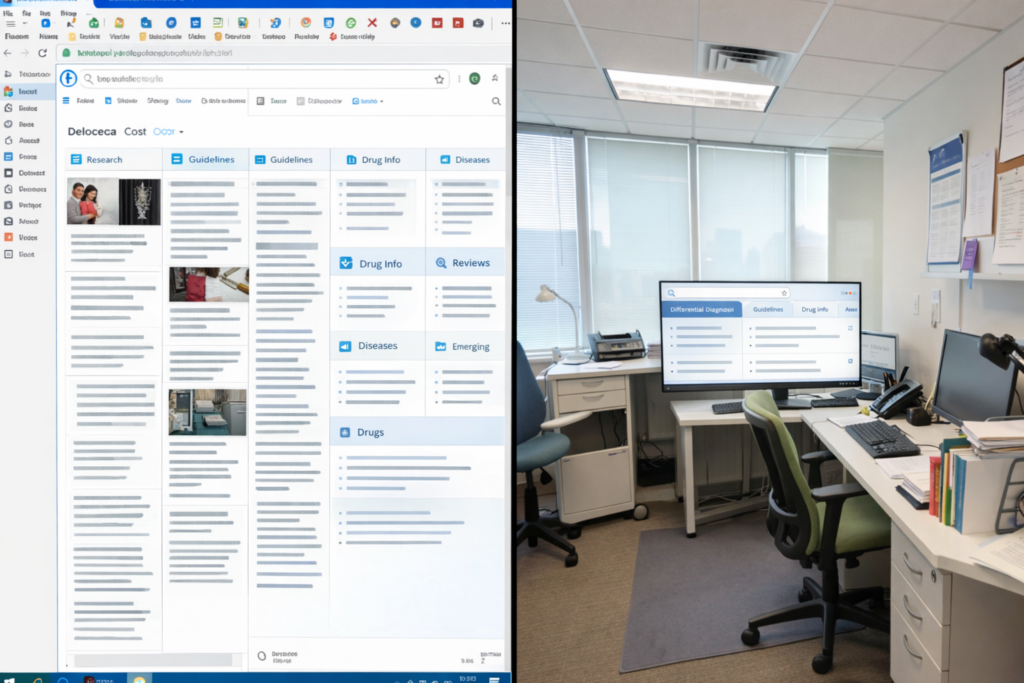
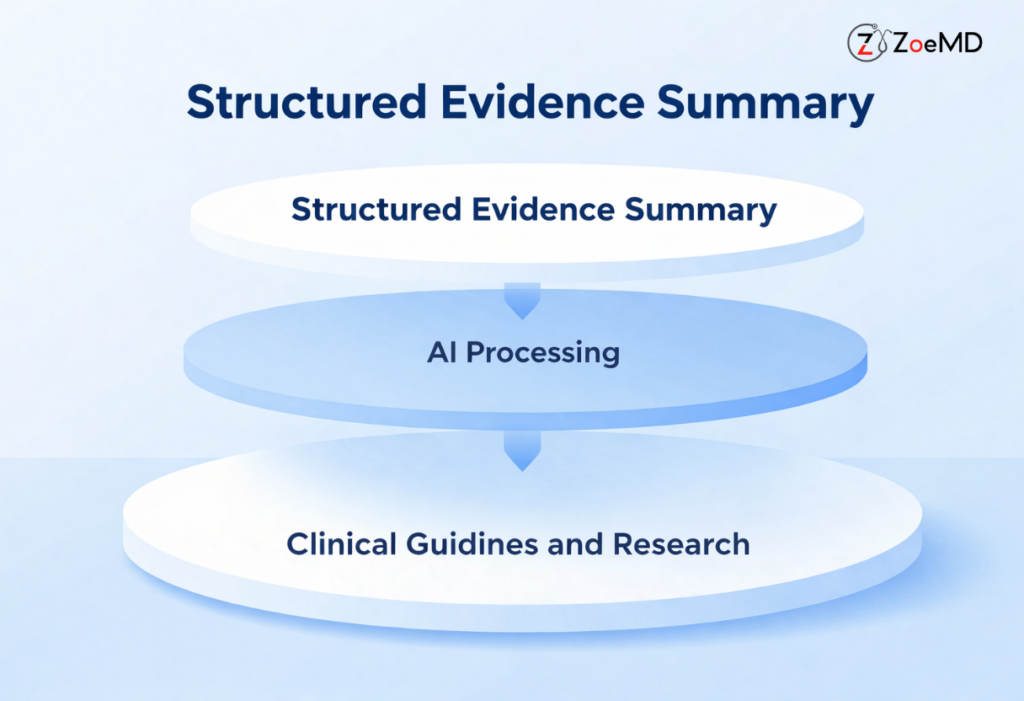
The most reliable AI medical assistants today are built on a retrieval-augmented design. Instead of generating responses from general training data alone, they:
- Retrieve relevant excerpts from vetted medical sources
- Anchor responses to those sources
- Present evidence in structured, reviewable form
This architecture reduces hallucination risk and increases trust.
ZoeMD’s framework, discussed in detail in Evidence Retrieval AI, ensures that responses are grounded in clinical guidelines, systematic reviews, and peer-reviewed research before synthesis occurs.
In practical terms, this means clinicians can see not just conclusions, but how those conclusions are supported.
AI Medical Assistant vs. Traditional Clinical Decision Support
It’s important to distinguish between an AI medical assistant and older clinical decision support systems (CDSS).
Traditional CDSS tools typically:
- Trigger alerts
- Provide protocol-based recommendations
- Operate within narrow rule sets
An AI-powered clinical assistant, by contrast, can:
- Interpret nuanced questions
- Weigh multiple evidence sources
- Highlight areas of uncertainty
- Compare conflicting studies
This evolution moves beyond static rules and into conversational, context-aware reasoning.
For example, ZoeMD’s AI Symptom Checker for Clinicians demonstrates how structured symptom input can be transformed into evidence-based reasoning rather than simplistic condition matching.
The Role of the AI Medical Assistant in Research
Medical knowledge doubles rapidly. Staying current requires continuous literature engagement.
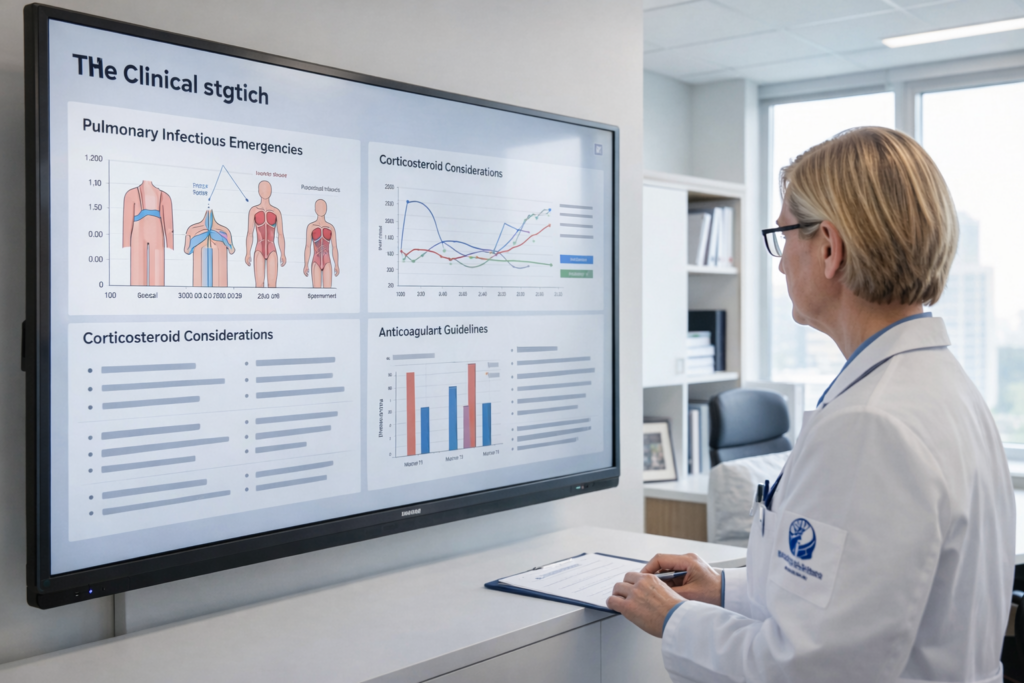
An AI medical assistant can function as a structured research collaborator by:
- Summarizing systematic reviews
- Comparing clinical trial outcomes
- Highlighting methodological differences
- Organizing real-world evidence
This research-focused functionality is explored in depth in ZoeMD’s post on the Medical Research Assistant, which explains how AI can reduce manual literature review burdens without compromising rigor.
Importantly, this support enhances—not shortcuts—the clinician’s analytical process.
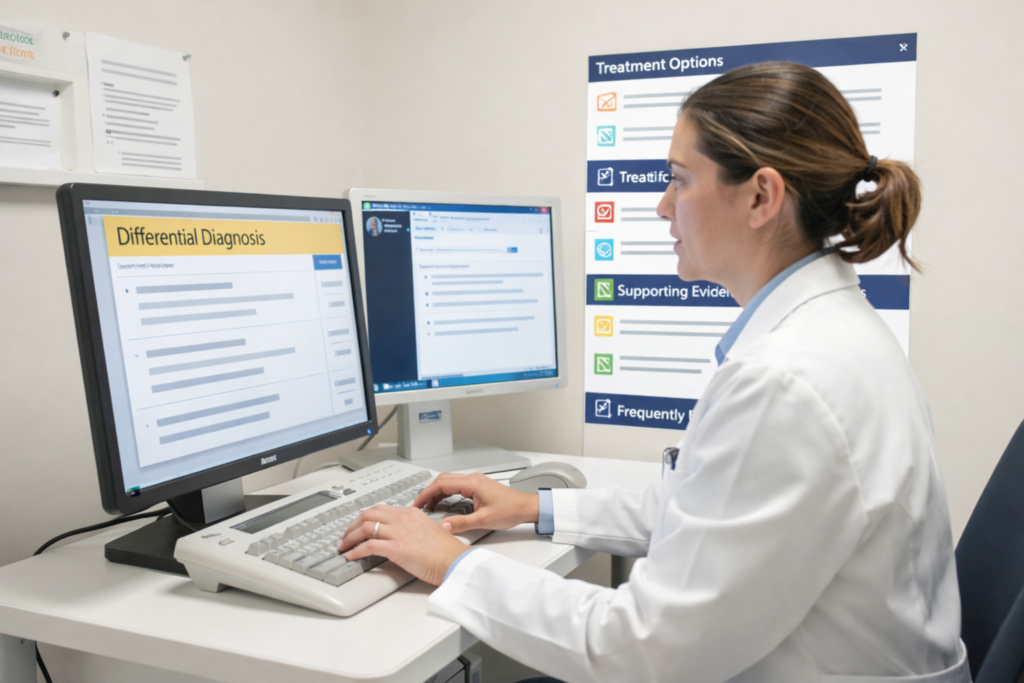
AI Medical Assistant in Clinical Workflow
In daily practice, an AI medical assistant may assist with:
- Differential diagnosis exploration
- Treatment comparison
- Evidence hierarchy clarification
- Risk factor contextualization
Rather than replacing clinical thinking, the assistant acts as a structured extension of it.
This aligns closely with ZoeMD’s broader positioning within Medical Research AI, where the focus remains on evidence-first design rather than automated decision-making.
The key distinction: clinicians remain in control.

Reducing Cognitive Load and Burnout
Healthcare burnout is not driven by clinical reasoning alone—it is driven by fragmentation, documentation overload, and constant task switching.
An AI medical assistant reduces cognitive friction by:
- Consolidating evidence into a single interface
- Eliminating repetitive manual searches
- Structuring information clearly
While AI cannot solve systemic issues alone, workflow support plays a meaningful role in burnout mitigation. ZoeMD addresses this broader challenge in its analysis of physician burnout solutions.
By reducing unnecessary mental overhead, AI tools can restore focus to clinical judgment rather than administrative navigation.
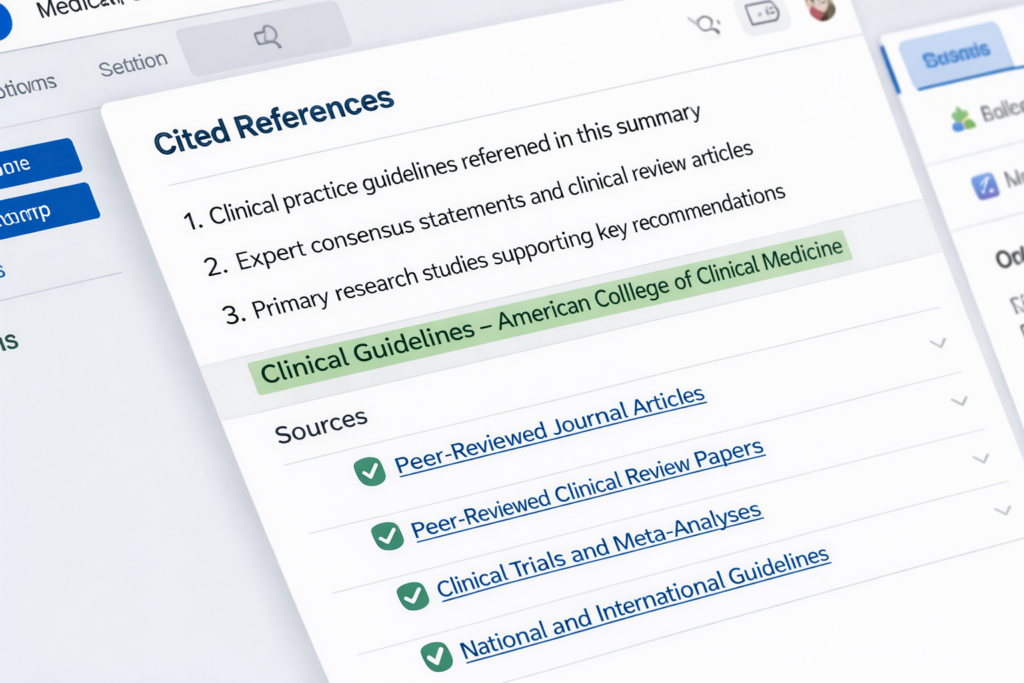
AI Medical Assistant and Evidence-Based Medicine
Evidence-based medicine depends on three pillars:
- Best available research
- Clinical expertise
- Patient context
A reliable AI medical assistant supports the first pillar while respecting the second and third.
By grounding responses in retrieved evidence and presenting it conversationally, AI enhances the clinician’s ability to integrate research into individualized care.
This is particularly relevant in complex cases where guidelines may conflict or patient comorbidities limit applicability.
Unlike consumer-facing tools, a clinician-focused AI assistant does not oversimplify nuance.
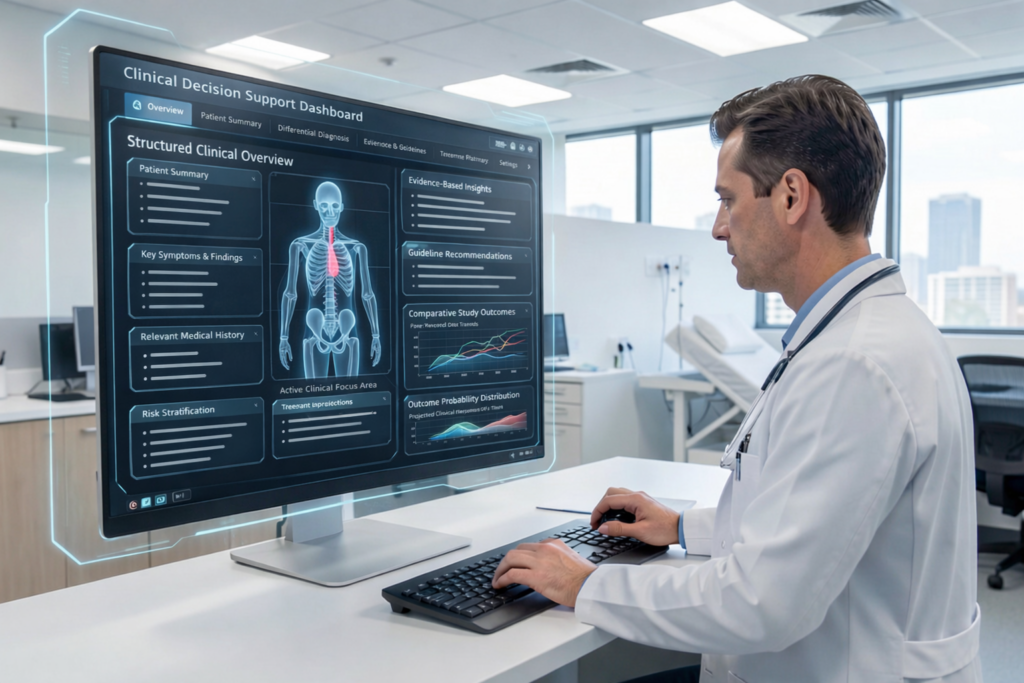
What an AI Medical Assistant Is Not
To avoid confusion, it’s equally important to clarify what an AI medical assistant is not:
- It is not a replacement for clinical training
- It is not a diagnostic automation system
- It is not a patient-facing chatbot
- It is not an unsupervised generative AI tool
The distinction matters.
General-purpose AI systems trained broadly on internet data cannot meet the evidentiary standards required in clinical practice. A medical AI assistant must operate within a carefully designed retrieval and verification framework.
This is why systems grounded in evidence retrieval and structured reasoning are essential.
Security, Transparency, and Trust
As healthcare AI adoption grows, clinicians and institutions increasingly ask:
- Where does the information come from?
- Can I verify the source?
- How is patient data handled?
Modern AI medical assistants prioritize:
- Source traceability
- Evidence citation
- Context transparency
- Compliance with healthcare standards
Trust is not built through speed—it is built through verifiability.
The Future of the AI Medical Assistant in 2026 and Beyond
Looking ahead, the AI medical assistant is evolving from a search-support tool into an integrated clinical reasoning partner.
Future developments may include:
- Deeper integration with EHR systems
- Real-time literature updates
- Personalized evidence weighting
- Advanced real-world evidence synthesis
However, the central principle remains unchanged: AI should support clinicians, not displace them.
The strongest systems will continue to prioritize retrieval-grounded design, transparency, and clinician oversight.
Final Thoughts: A Tool for Thinking, Not Replacing
In 2026, the AI medical assistant represents a shift in how clinicians engage with medical knowledge. It transforms fragmented literature retrieval into structured, conversational insight.
When designed responsibly—with retrieval-augmented reasoning, verifiable sources, and clinician-first workflows—an AI medical assistant becomes a powerful extension of clinical expertise.
ZoeMD’s ecosystem—including its AI medical search engine, medical research assistant, and evidence retrieval architecture—reflects a commitment to this evidence-grounded approach.
For clinicians navigating complexity, the goal is not automation. It is clarity.
And clarity, in medicine, saves time, reduces uncertainty, and ultimately supports better care.