
In modern healthcare, Clinical Decision Support Systems (CDSS) have become indispensable tools for improving diagnostic accuracy, patient outcomes, and operational efficiency. With the increasing integration of AI and evidence-based medicine, systems like ZoeMD are redefining how clinicians access and apply medical knowledge in real time.
This comprehensive guide explores what CDSS are, their key benefits, and a step-by-step roadmap to implement them effectively in your medical practice.
What Is a Clinical Decision Support System (CDSS)?
A Clinical Decision Support System is a software solution that analyzes data from various sources—such as public lab results, peer-reviewed research papers, and medical literature—to help clinicians make informed decisions. CDSSs deliver tailored recommendations, alerts, and clinical insights at the point of care.
Unlike traditional reference systems, modern CDSS tools like ZoeMD’s AI-powered platform go beyond static databases. They leverage machine learning and natural language processing (NLP) to answer clinical questions with verified, evidence-based sources, helping doctors stay informed and confident in their choices.
Core Components of a CDSS
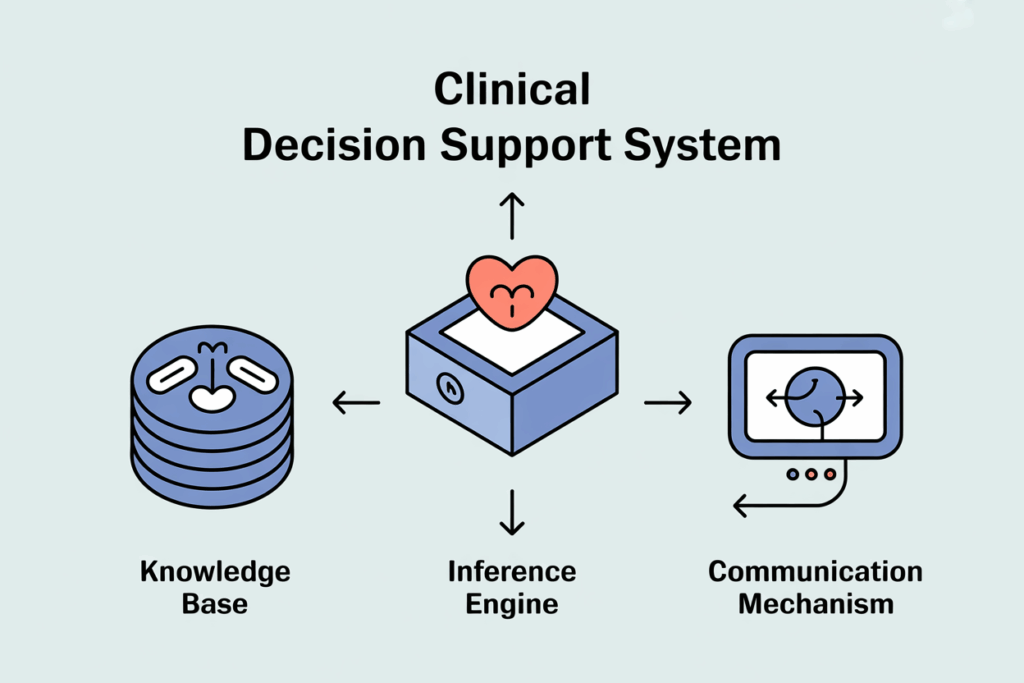
- Knowledge Base: A curated collection of clinical guidelines, medical literature, and case studies.
- Inference Engine: The system that applies medical logic to interpret data and generate recommendations.
- Communication Mechanism: The interface that presents actionable insights to the clinician (e.g., alerts, reminders, or research summaries).
Modern CDSS platforms like ZoeMD integrate these elements seamlessly with AI-driven reasoning and trusted evidence sources.
Benefits of Clinical Decision Support Systems
1. Improved Diagnostic Accuracy
CDSS tools cross-reference patient symptoms, test results, and medical history against vast medical databases to suggest likely diagnoses and potential comorbidities.
Example: ZoeMD’s evidence-based AI provides clinicians with references to recent clinical trials, guidelines, and systematic reviews, ensuring decisions are supported by verified data.
2. Enhanced Patient Safety
Automated alerts for drug interactions, contraindications, and dosage errors significantly reduce medical errors. A well-configured CDSS improves medication safety and adherence to best practices.
3. Evidence-Based Medicine Made Simple
Rather than searching through journals manually, physicians can ask ZoeMD AI a clinical question and instantly receive peer-reviewed, evidence-based answers.
4. Increased Efficiency and Time Savings
By automating repetitive research and administrative tasks, CDSS platforms allow clinicians to focus on patient care. Integrating ZoeMD into your workflow can save hours of literature review time every week.
5. Standardized Care and Compliance
CDSS tools help align practices with clinical guidelines, regulatory standards, and institutional policies—ensuring every patient receives consistent, high-quality care.
6. Support for Clinical Research
AI-enhanced systems like ZoeMD serve as research assistants, summarizing findings and providing source links, making them invaluable for academic and research-driven medical practices.

Types of Clinical Decision Support Systems
CDSS solutions can vary in complexity and application. Here are the main categories:
- Knowledge-Based CDSS – These use predefined rules or medical guidelines to provide recommendations.
- Machine Learning-Based CDSS – These leverage predictive modeling and AI to analyze patient data and suggest outcomes.
- Passive CDSS – Provide information upon request (e.g., ZoeMD’s query-based research assistant).
- Active CDSS – Deliver alerts or reminders automatically during clinical workflows.
Most healthcare organizations benefit from a hybrid approach that combines real-time AI queries with automated rule-based alerts.
Implementation Guide: How to Use CDSS as a Doctor
Integrating a Clinical Decision Support System doesn’t need to be complex—especially for individual physicians. Here’s a simplified, doctor-focused roadmap:
- Start with your workflow: Identify moments in patient care where you most often need quick evidence or reassurance—such as differential diagnosis, drug interactions, or confirming treatment protocols.
- Choose an evidence-based tool: Select a CDSS like ZoeMD, which allows you to ask clinical questions in plain language and get answers supported by verified studies and guidelines.
- Incorporate it into daily practice: Use it as a real-time assistant during consultations or charting. For example, when uncertain about the latest treatment for a condition, simply ask ZoeMD and review the cited evidence instantly.
- Evaluate and refine: After using it for a few weeks, note which types of queries save the most time or improve accuracy. Adjust how and when you use it to make it a natural part of your clinical reasoning process.
ZoeMD’s conversational AI is designed to fit seamlessly into a doctor’s routine, enhancing decision-making without disrupting patient interactions.
Common Challenges and How to Overcome Them
| Challenge | Solution |
|---|---|
| Resistance to adoption | Involve clinicians early, highlight time-saving benefits, and show examples of improved outcomes. |
| Data integration issues | Work with IT to ensure EHR compatibility and standardize data formats. |
| Information overload | Customize alert settings and relevance filters to avoid alert fatigue. |
| Maintaining data quality | Use AI systems like ZoeMD that automatically cite and verify sources. |

Measuring the Effectiveness of a CDSS
Implementing a CDSS should demonstrate clear value. Measure success by tracking:
- Reduced diagnostic errors (pre- vs post-implementation)
- Shorter decision-making times
- Improved patient outcomes and satisfaction
- Lower operational costs due to efficiency gains
Clinics using evidence-based AI tools like ZoeMD report substantial reductions in research time and improved confidence in clinical reasoning.
Why Choose ZoeMD for Evidence-Based Clinical Decision Support
Unlike generic CDSS software, ZoeMD offers a conversational, research-oriented AI built specifically for clinicians. You can ask ZoeMD complex medical questions—such as “What’s the latest evidence for treating diabetic neuropathy?”—and receive clear, structured answers backed by verified academic sources.
Key Features:
- Evidence-based insights with source citations
- AI-assisted medical research for clinical and academic use
- Intuitive interface optimized for physicians
- HIPAA-compliant data handling
ZoeMD bridges the gap between clinical decision-making and real-time medical research, giving healthcare professionals a reliable assistant for evidence-based practice.
Conclusion
As healthcare becomes increasingly data-driven, Clinical Decision Support Systems are essential for ensuring accuracy, safety, and efficiency. By implementing a robust, evidence-based CDSS like ZoeMD, medical practices can empower their teams to make better decisions—supported by science, guided by AI, and validated by evidence.
To explore how ZoeMD’s AI can support your clinical decision-making, visit ZoeMD’s Evidence-Based Medical AI page and see how it transforms medical knowledge into actionable insights.